A Complete Guide to Visiting Du Fu Thatched Cottage in Chengdu
This comprehensive guide is designed to be your ultimate companion for exploring Du Fu Thatched Cottage. We’ll take you beyond the surface, delving into the rich history that shaped this site, highlighting the unmissable attractions that tell Du Fu’s story, and uncovering the cultural experiences that let you interact with his legacy firsthand. From practical details like opening hours and ticket prices to insider tips on avoiding crowds and savoring local flavors nearby, we’ve left no stoneunturned. Whether you’re a die-hard literature fan planning a deep dive into poetic history or a casual traveler looking for a serene escape from the city, this guide will ensure your visit is meaningful, smooth, and unforgettable.
 Discover Chengdu's Rich Cultural Tapestry: A Comprehensive One-Day Exploration
 2 Days Best Chengdu Food Tour with City Sightseeing
Overview
Du Fu Thatched Cottage is a historical site located in the southwest of Chengdu, built to commemorate the great Tang dynasty poet, Du Fu. Du Fu spent one of the most productive periods of his life here in Chengdu, and the cottage, where he lived and created, not only preserves a wealth of historical artifacts but also beautifully reflects the natural landscapes described in his poetry. Whether you're a literature enthusiast, a history researcher, or an ordinary tourist, Du Fu Thatched Cottage is a must-visit cultural landmark.
About Du Fu and Du Fu Thatched Cottage
1. Du Fu: A Brief Introduction
Du Fu (712-770), courtesy name Zimei and also known as Shaoling Yelao, was a great realistic poet of the Tang Dynasty. He was known together with Li Bai as "Li Du" and honored as the "Poet Sage" by later generations. Born into an official family in Gong County, Henan, he studied extensively from an early age and harbored the political ambition of "assisting the emperor to reach the realm of Yao and Shun, and restoring the pure customs of the people". However, his life was marked by the turmoil of the An Lushan Rebellion, a bumpy official career, and long-term wandering.
From Chang'an to Chengdu, from Kuizhou to Tanzhou, during his wandering journey, he witnessed the hardships of the people and the decline of society under the war, and poured these profound experiences into his poetry creation. Du Fu's poems are known as "poetic history" because they truly and profoundly record the historical changes and the lives of the people during the Tang Dynasty's transition from prosperity to decline. His works cover a wide range of themes, including worries about the fate of the country (such as "The country is broken, but the mountains and rivers remain; the city is spring, but the grass and trees are deep" in *Spring View*), compassion for the bottom people (such as "How angrily the officials shout, how bitterly the woman cries" in *Shihao Official*), sighs about his own situation (such as "Wandering for ten thousand miles in the sad autumn, often a stranger; suffering from illnesses for a hundred years, alone on the heights" in *Ascending the Height*), and perseverance in ideals and beliefs (such as "How can I get a thousand spacious mansions to shelter all the poor scholars in the world from the cold" in *A Thatched Cottage Ruined by the Autumn Wind*). His poetry style is melancholy and forceful, with concise and accurate language, combining ideology and artistry, which has exerted an inestimable influence on the development of Chinese classical poetry in later generations and become a bright treasure in the cultural treasure house of the Chinese nation.
2. Historical Background of Du Fu Thatched Cottage
The story of Du Fu Thatched Cottage begins in 759 AD, a turbulent time in Tang Dynasty history. After fleeing the chaos of the An Lushan Rebellion, Du Fu, then 47 years old, arrived in Chengdu seeking refuge. With the help of local friends, he built a simple thatched cottage on the banks of the Huanhua River, a place where he could find peace amid the turmoil. For nearly four years (760-762 AD), this humble abode became his sanctuary. It was here that he composed some of his most celebrated works, including "A Thatched Cottage Ruined by the Autumn Wind," a poignant cry for the suffering of the common people, and "Ode to the Plum Blossom," a tender tribute to resilience. Tragically, the original cottage was destroyed by floods and wars in the centuries that followed. However, its memory endured—later rulers and literati repeatedly restored and expanded the site, turning it into the grand complex we see today, a testament to the enduring reverence for Du Fu’s genius.
Exploring Du Fu Thatched Cottage
Du Fu Thatched Cottage Museum is divided into three functional areas: the Cultural Relic Scenic Area, the Garden Scenic Area, and the Service Area.
Within the Former Site of the Thatched Cottage, the screen wall, main gate, Great Hall, Hall of Poetry and History, Firewood Gate, and Gongbu Shrine are arranged along a central axis. Flanked by symmetrical corridors and other auxiliary buildings, the area features winding streams, connecting stone bridges, and lush greenery of bamboos and trees. It exudes an atmosphere that is both solemn and dignified, simple and elegant, as well as serene and secluded, beautiful and clear.
Main Attractions
1. Front Gate
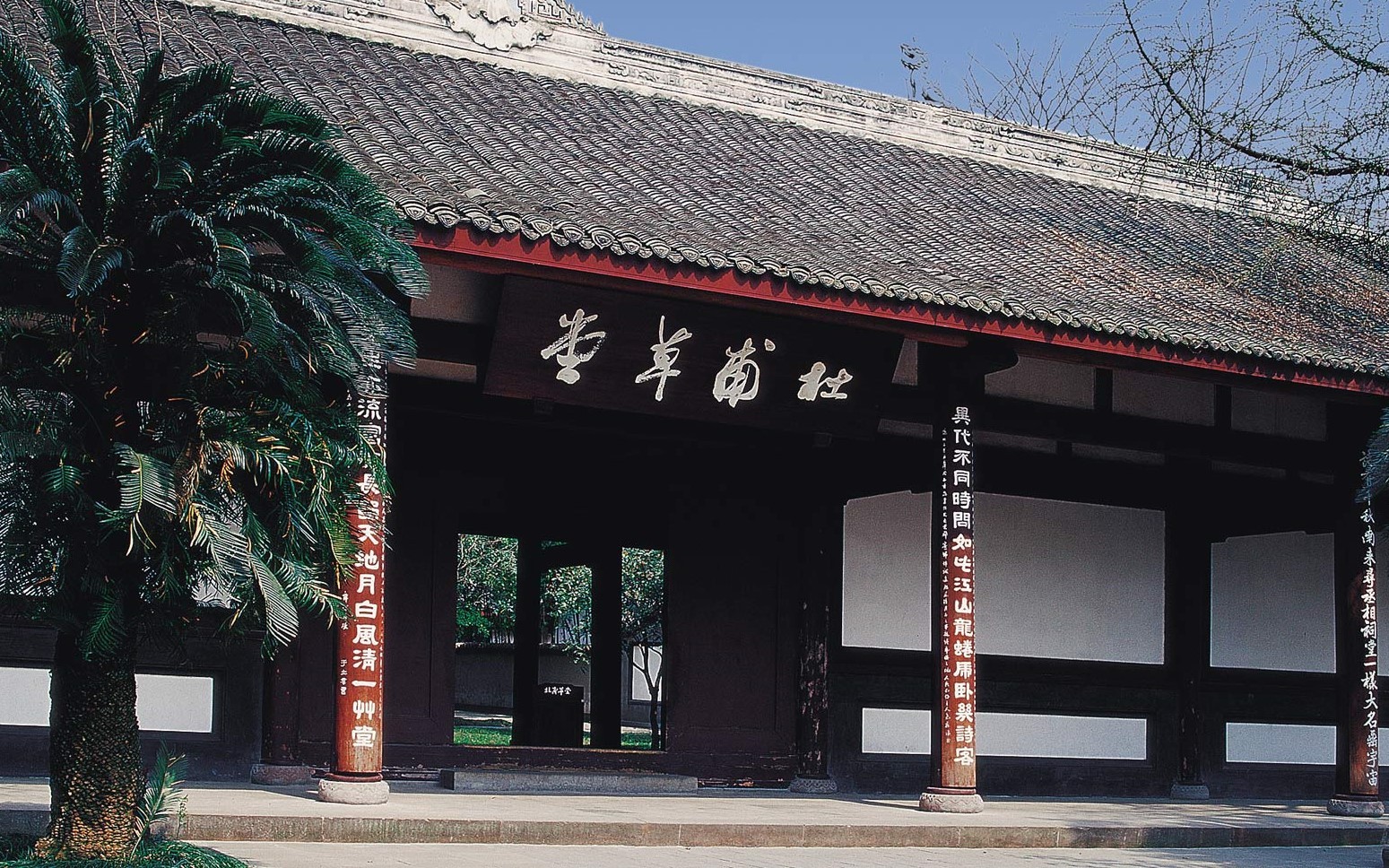
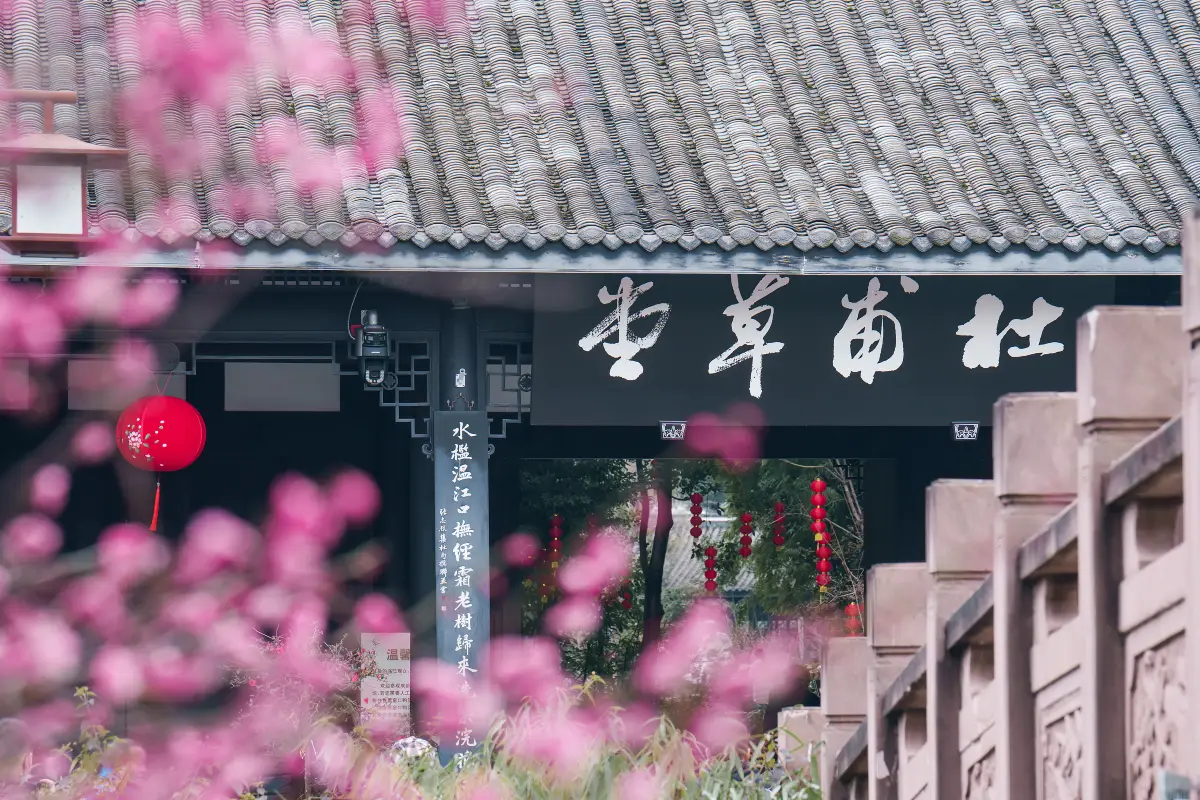
The Front Gate of the Thatched Cottage is the first part of the old building complex. The two Chinese characters “Caotang” (Thatched Cottage) on the inscribed board were replicated from the “Shaoling Caotang” (Shaoling Thatched Cottage) Tablet inscribed by Aisin Gioro Yunli — Prince Guo of the Qing Dynasty. In ancient Chinese architecture, an inscribed board over the front gate and a couplet on its both sides are indispensable. In the couplet by the gate “West to the Wanli Bridge, North to Baihua Pond”, Du Fu has indicated the geographical location of the Thatched Cottage concisely.
2. Grand Lobby
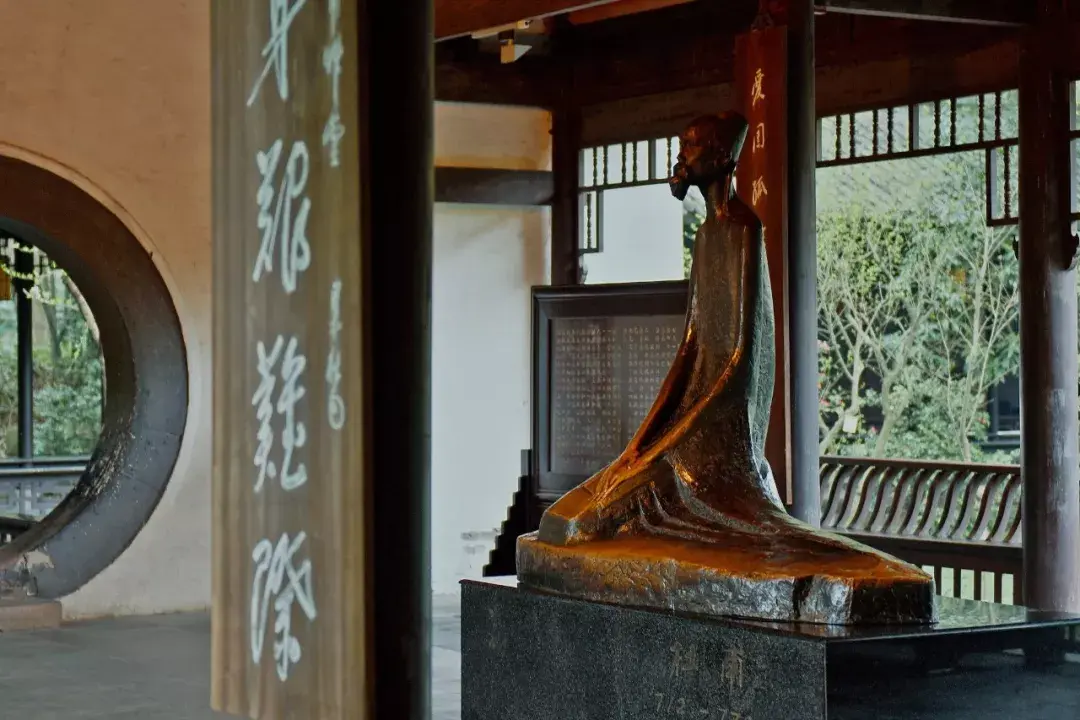
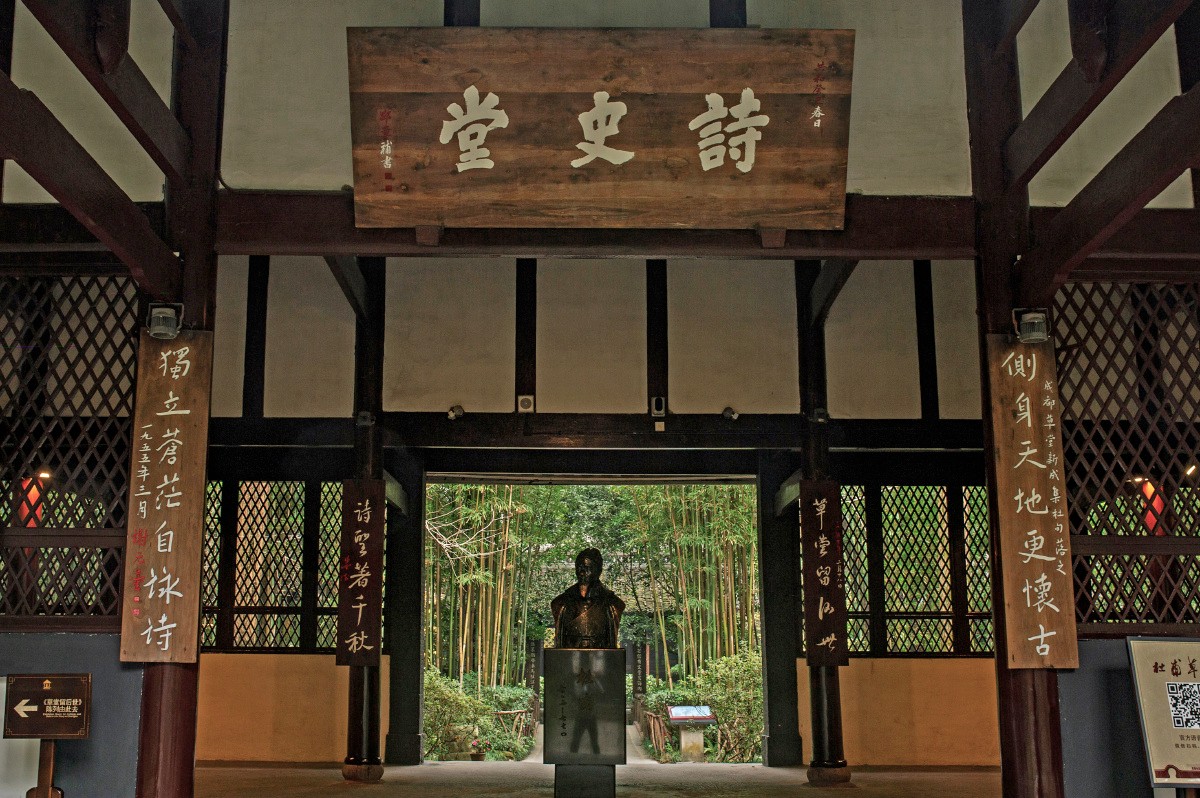
The copper statue in front of the Grand Lobby depicts the poet in his old-age predicament, sitting on the prow, contemplating with a book in hand. The statue was created by Mr. Qian Shaowu, a renowned Chinese contemporary sculptor and a professor at the Central Academy of Fine Arts.
Carved on the statue seat are the birth and death years of Du Fu. Born in Gongxian County of Henan in 712, the poet died of illness on a boat on Xiangjiang River of Hunan in 770. Growing up in an aristocratic family of government officials, Du Fu developed an entrenched respect for Confucianism. He served Military Affairs Officer in the Right Guard Court, Left Court Officer, and Advisor of the Jiedushi Office (Advisor in Gongbu (the Ministry of Works in Feudal China)) throughout his life. Though none of them was an important position, he bore unflinching love for his country and its people. To commemorate his patriotism and compassion, later generations repaired his residence during the resign of Emperor Jiaqing in the Qing Dynasty and named it Grand Lobby, a typical designation for government offices in ancient China.

3. Memorial of the Poet-Historian
In the center of the Memorial stands a copper statue created by Mr. Liu Kaiqu, a celebrated sculptor in modern China, who masterfully portrayed Du Fu in his post-adolescence and his strong patriotism.
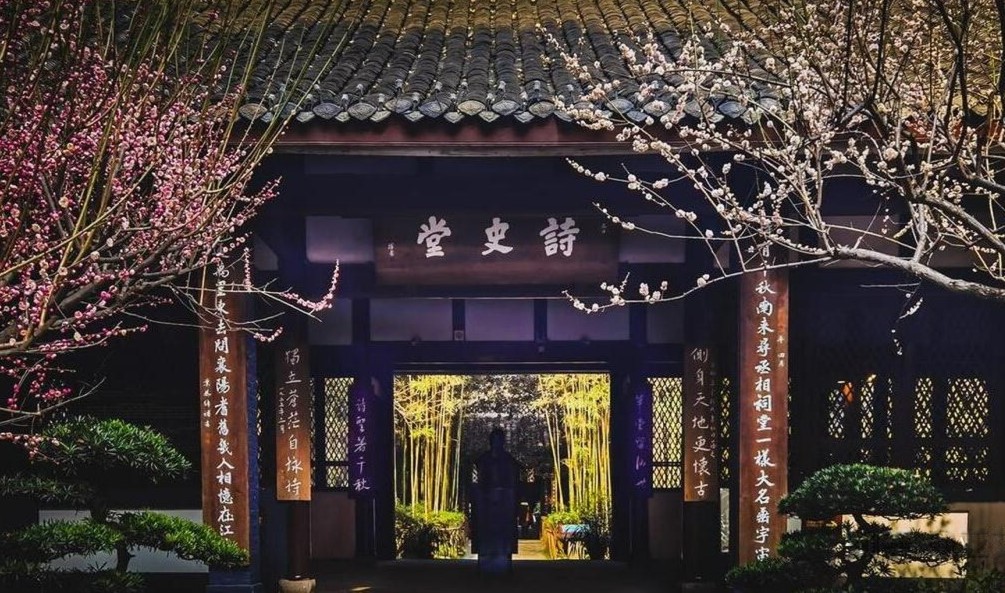
Since his works mark tremendous achievements in both ideological and artistic senses, Du Fu enjoys a supreme status in the history of Chinese literature. Transcending national boundaries, his poems are valuable treasure of human culture. In 1962, Du Fu was commemorated as a world cultural personage, sharing equal honor with literary giants including Homer of the Ancient Greece, Byron and Shelley of the UK, Goethe and Heine of Germany, Pushkin and Lermontov of Russia, and Tagore of India. His poems have been translated into over 20 languages. The Poetry of Du Fu published by Stephen Owen, a famous American sinologist, in 2016 is the first full translation of Du Fu’s poems into English.
Hanging in the middle is a couplet by Marshal Zhu De, “Cottage Story, Poet Sage”, a critical acclaim for Du Fu Thatched Cottage as a poetic cradle inspiring later generations and the poetic accomplishment of Du Fu flowing down for long ages.
4. Firewood Gate
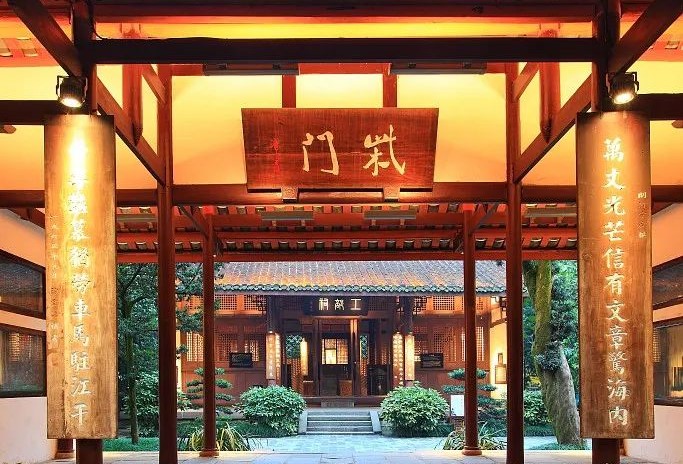
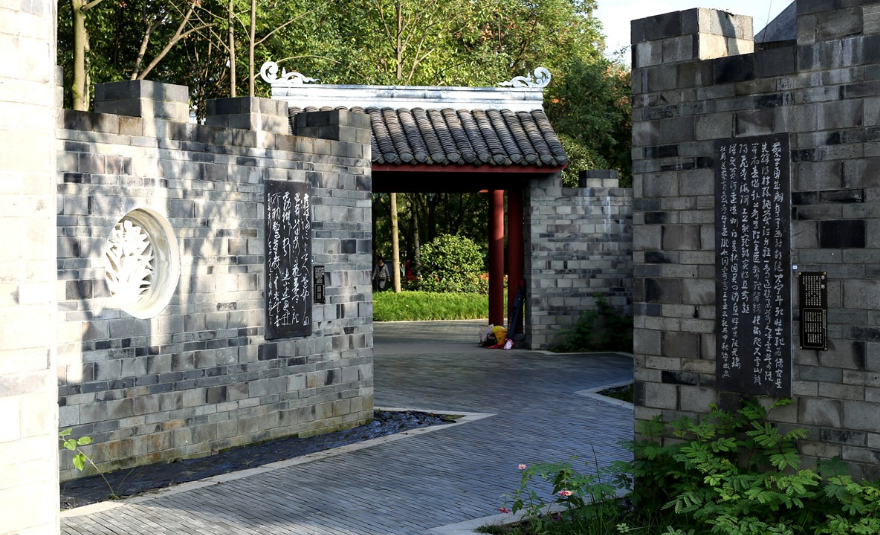
Walking past the stone arch bridge, we arrive at the Firewood Gate — the smallest among the five buildings along the central axis. The spot was designated as the “Depth of the Blossom-Bathing Brook” during the Ming Dynasty and “Flowery Path with Herbal Fence” during the Qing Dynasty. Du Fu once called his courtyard gate the Firewood Gate in a poem, hence the name in the 1960s. The two characters “Chaimen” (Firewood Gate) on the board were inscribed by Mr. Pan Tianshou, a modern Chinese ink painting master.
Walking through the Firewood Gate and stepping on the rugged flagging, we may naturally recall the scene where visitors flock to the site to pay homage to Du Fu. The seven tablets in walls on both sides present poems left by men of letters or local officials during the Qing Dynasty to express their respect and admiration for the poet sage.

5. Gongbu Shrine
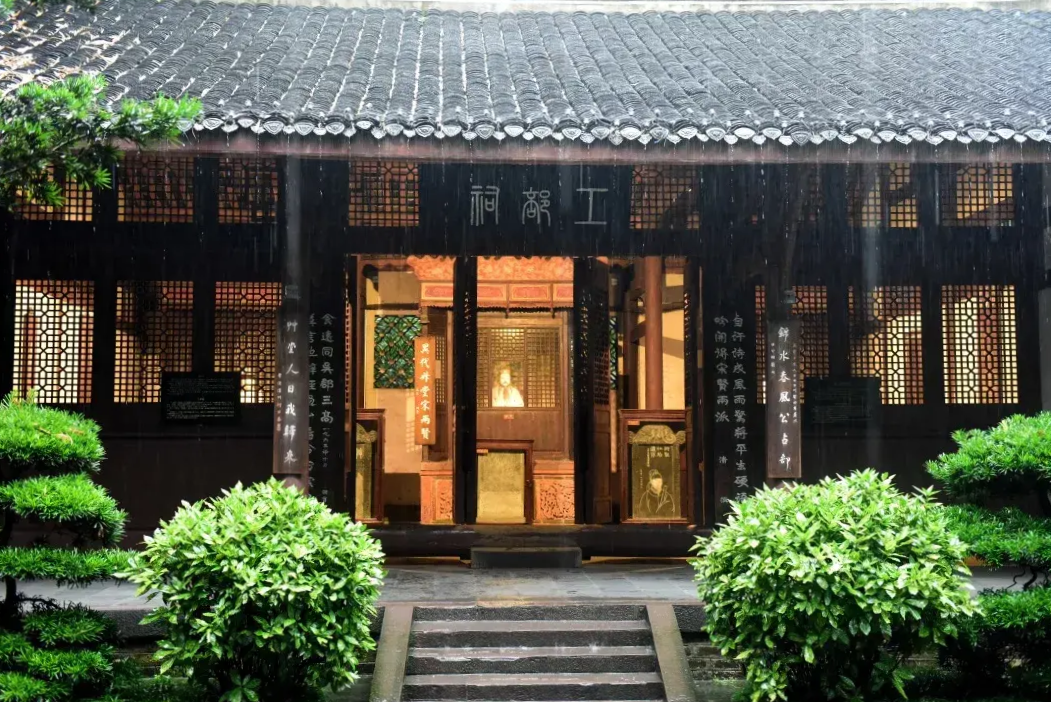
The Gongbu Shrine stands as the last building along the central axis of the Thatched Cottage. The three Chinese characters “Gongbuci” (Gongbu Shrine) on the board were inscribed by the celebrated Chinese litterateur Ye Shengtao. “Gongbu” or the Ministry of Works is one of the six ministries in ancient Chinese administrative system, in charge of construction work. Given the tradition that men of letters in ancient China generally nicknamed themselves by their position, service organ or location, Du Fu was known as Du Shiyi or Du Shaoling. During his sojourn in Chengdu, Du Fu was appointed Advisor of the Jiedushi Office (Advisor in Gongbu (the Ministry of Works in Feudal China)), so he was addressed as Du Gongbu. The establishment Gongbu Shrine was completed to commemorate him.

6. Tablet Pavilion
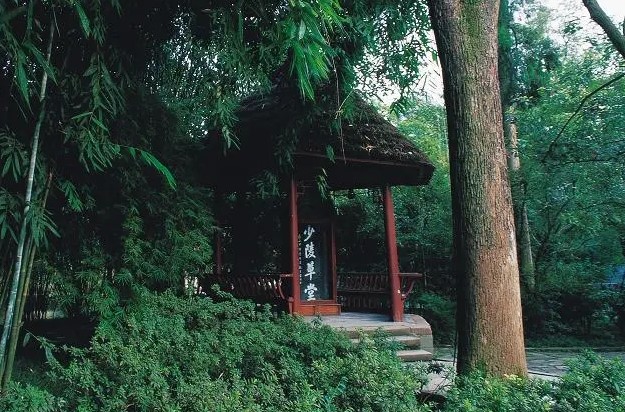
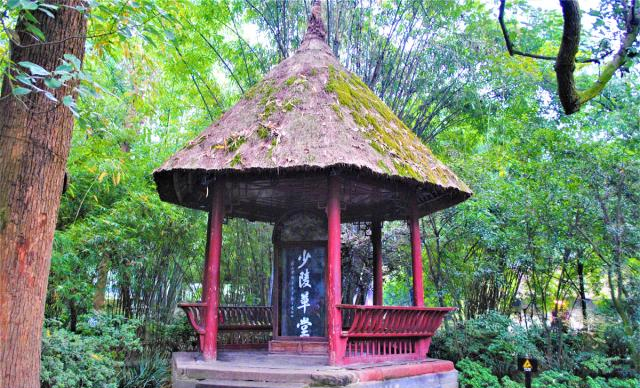
The Tablet Pavilion, at east of the Gongbu Shrine, is around 175cm tall and 80cm wide, engraved with patterns of two dragons frolicking with a pearl on its head as well as dragon patterns at its body top and both sides. Seeing off Dalai Lama back to Tibet, Prince Guo of the Qing Dynasty Aisin Gioro Yunli made a special trip to Taining (west of Kangding, Sichuan today) in 1734. When stopping by the Thatched Cottage in Chengdu, he left four Chinese characters “Shaoling Caotang” (Shaoling Thatched Cottage) as Shaoling marks another alias of Du Fu. During the Thatched Cottage renovation in 1811, Sichuan governor Chang Ming and administrator Fang Ji ordered a tile-roofed house completed to shelter the “Shaoling Thatched Cottage” Tablet. During the period of the late Qing Dynasty and the early Republic of China, the tile-roofed house was replaced with a thatched hexagonal pavilion to echo the Thatched Cottage. In a simple and delicate style, the Tablet Pavilion has become one of the hallmarks at the Chengdu Du Fu Thatched Cottage today.
7. Thatched Cottage Scenic Area
Heading northward of the Tablet Pavilion through a wooden bridge, we come to the former residence of Du Fu renovated as per description in Du’s poems. Restoring the scene of the poet’s stay here, the Cottage allows visitors to truly experience what a poetic life Du Fu once lived.
In authentic western Sichuan architectural style, the Cottage employs the wooden mortise and tenon structure. Mortise and tenon are wooden joints that were used in architecture, furniture, and other woodwork in ancient China. Mortise (the convex part) and tenon (the concave part) connect two or more wooden pieces together, seamless and ingenious. The Cottage is equipped with clay-bamboo walls and a thatched roof. The gate ahead on your left, known as the Firewood Gate, is made of wood, short and crude. Walking inside the yard, you would discover four pine trees on the left, five peach trees on the right, a herbal garden and a vegetable garden set apart on both sides, a living room in the middle, and a bedroom next to the kitchen in the east. Du Fu’s study is west of the living room, followed by the bedroom for his children. During his stay at the Thatched Cottage, Du Fu lived a comparatively leisurely and self-sufficient life.


8. Flowery Path
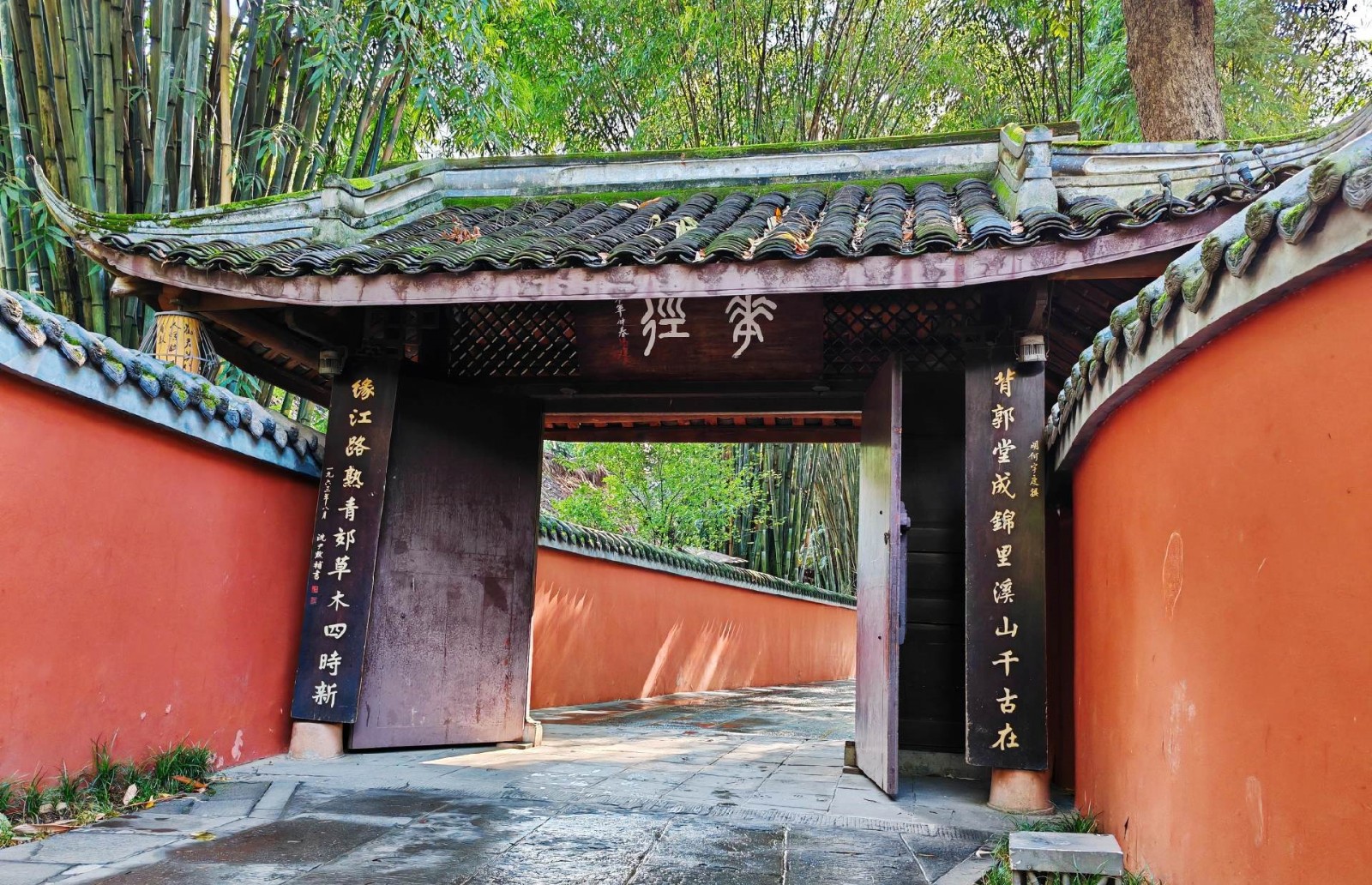
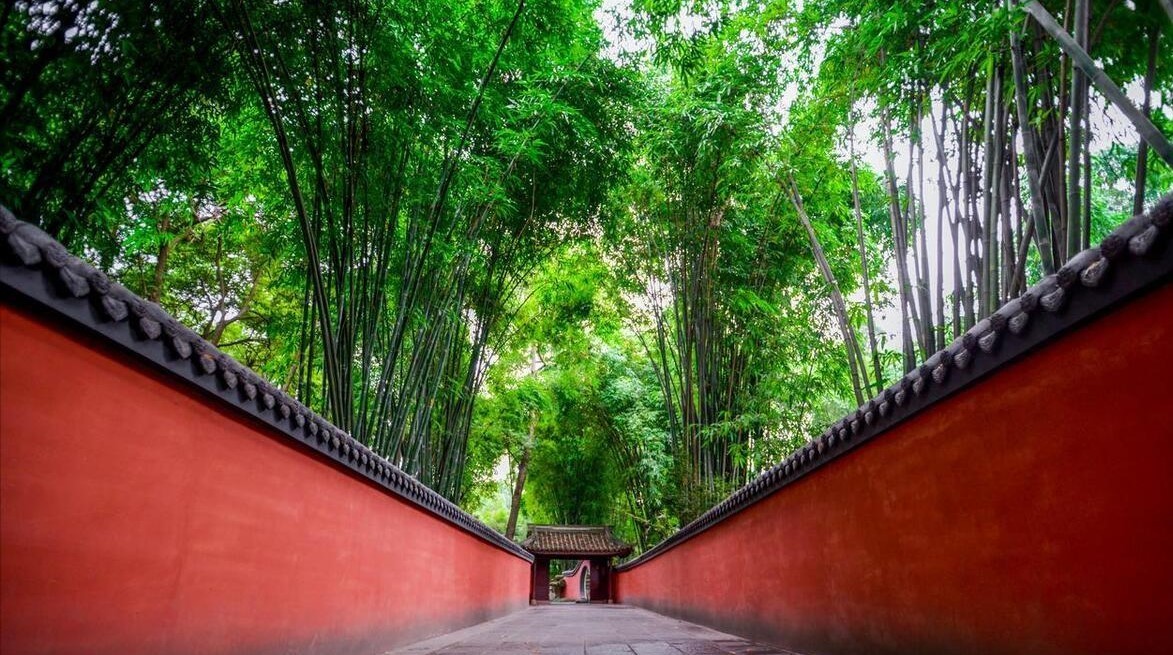
This path laid is the Flowery Path. Du Fu once mentioned in his poems that there was a path flanked by flowers and trees in front of his thatched cottage. Today’s Flowery Path actually refers to a red wall passage that links the former site of the Du Fu Thatched Cottage to the former Thatched Cottage Temple. Due to its beautiful scenery and poetic flavor, the path regularly shows up in Chengdu promotional video or films. The two characters “Huajing” (Flowery Path) on a board at the east entrance were inscribed by modern calligrapher Xiao Longyou. On the two columns at both sides of the gate is a couplet handwritten by Mr. Guo Moruo, reading “When flowers resemble a piece of red silk, the path brings spring to Jinli”.
9. Screen Wall of the Thatched Cottage
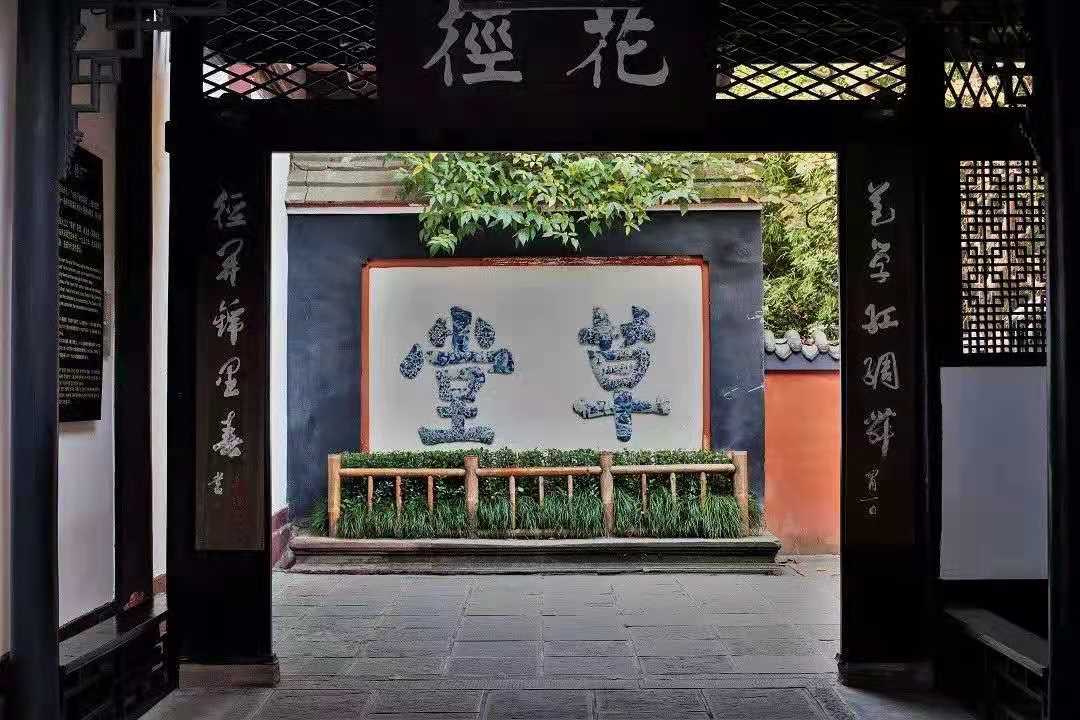
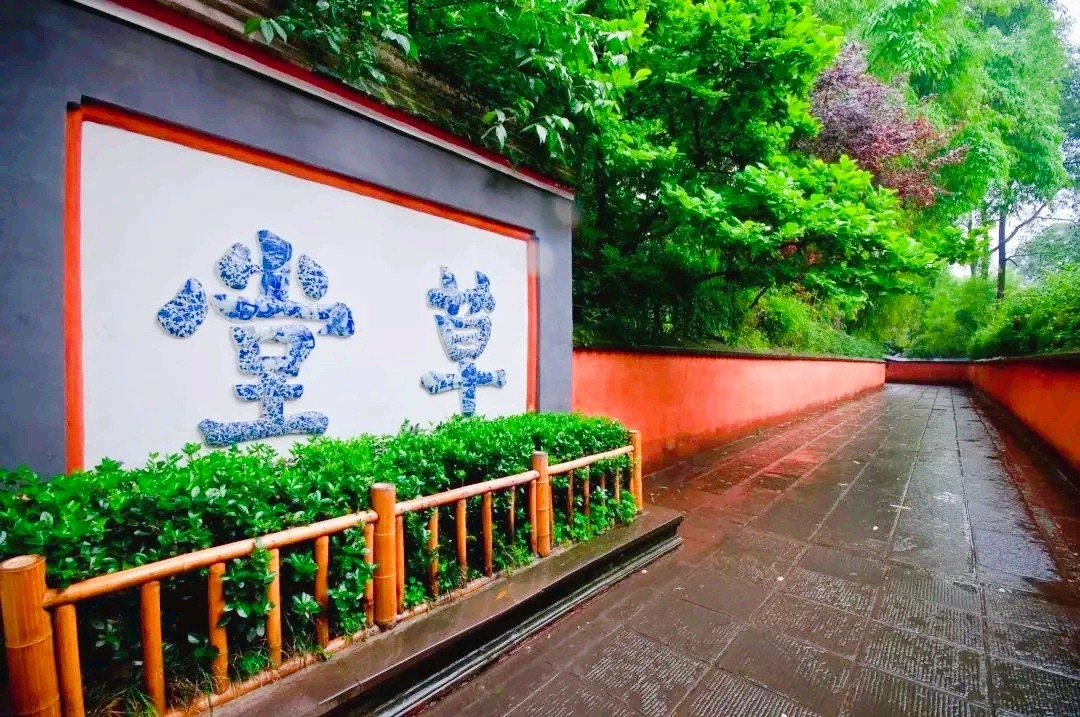
At the end of the Flowery Path is the Screen Wall of the Thatched Cottage, with the two characters “Caotang” (Thatched Cottage) inlaid with blue and white porcelain pieces. The country China is named for being the birthplace of chinaware, which is made with clay burnt in a temperature above 1,200°C and then covered with glaze. The blue and white porcelain is a major category of chinaware and was a popular export in the Chinese foreign trade history. This characteristic Chinese product was sold across the world during the Ming and Qing dynasties.
The two Chinese characters “Caotang” (Thatched Cottage) were originally written by an administrator of Sichuan industry and commerce named Zhou Shanpei in 1908 and built with broken porcelain, but were damaged later. The two embedded characters are a substituted version written by his younger brother Zhou Zhujun. As one of the most iconic spots in the Du Fu Thatched Cottage, a great deal of visitors have their pictures taken here as a souvenir. Among all photo takers, the best known is Mao Zedong who visited the Thatched Cottage in 1958 and left a precious rear view photo after a long gaze here.
10. Hall of Odes
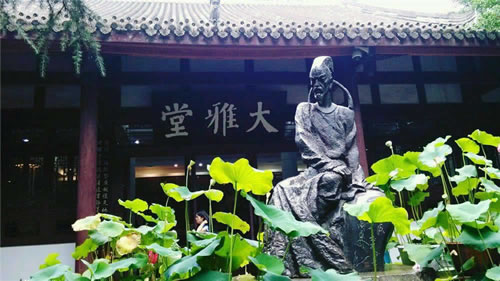
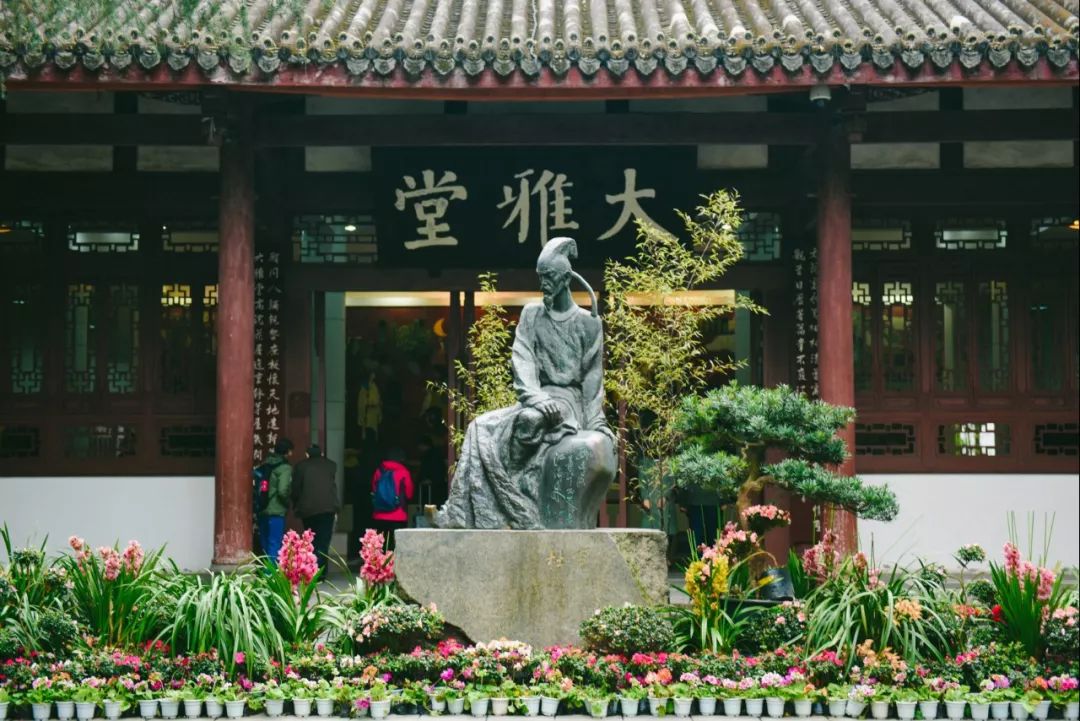
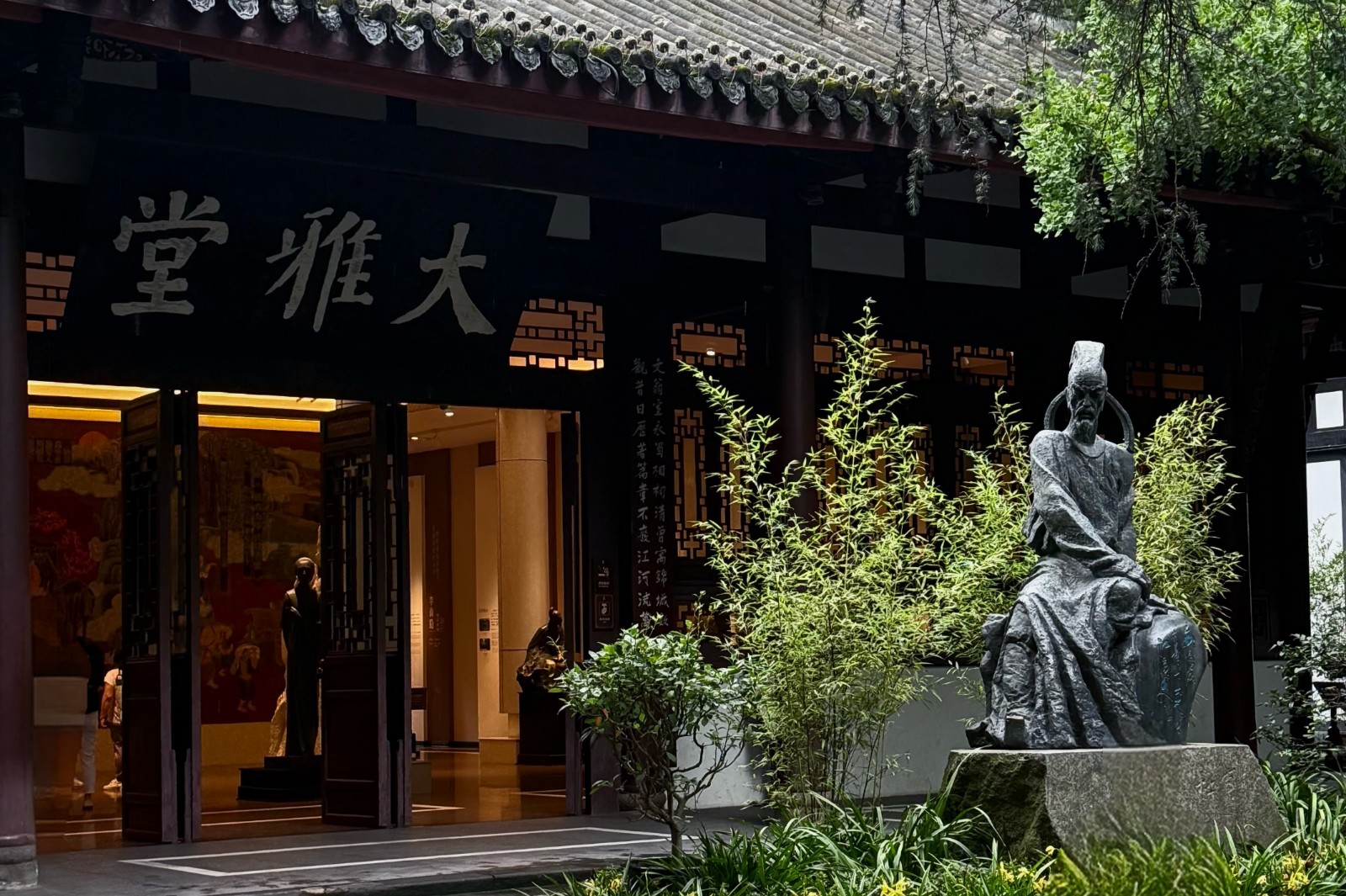
The Hall of Odes was formerly the Shakya Mani Hall of the Thatched Cottage Temple. Redesigned into a hall to exhibit Chinese poetry culture, it was opened to the public in 2002. The three characters “Dayatang” (Hall of Odes) inscribed on the board over the front gate are taken from handwritings of Yan Zhenqing, the prestigious calligrapher of the Tang Dynasty. “Daya” (Ode) is a part of the Book of Songs, the earliest poetry collection in China, which reflects major events in ancient society and is treated as the paragon of poetry. The Hall is thus named to show respect to the fine tradition of Chinese poetry. As a staunch fan of Du Fu’s poems, Yang Su from Danling of Sichuan in the Northern Song Dynasty once invited Huang Tingjian, a great poet who was demoted to Yibin of Sichuan at the time, to handwrite Du Fu’s poems composed in Sichuan; carved them all on stone tablets; and erected a hall in Danling for exhibition. Upon erection of the hall, Huang Tingjian named it Hall of Odes and composed an article entitled Records on the Hall of Odes.
11. Wanfo Tower
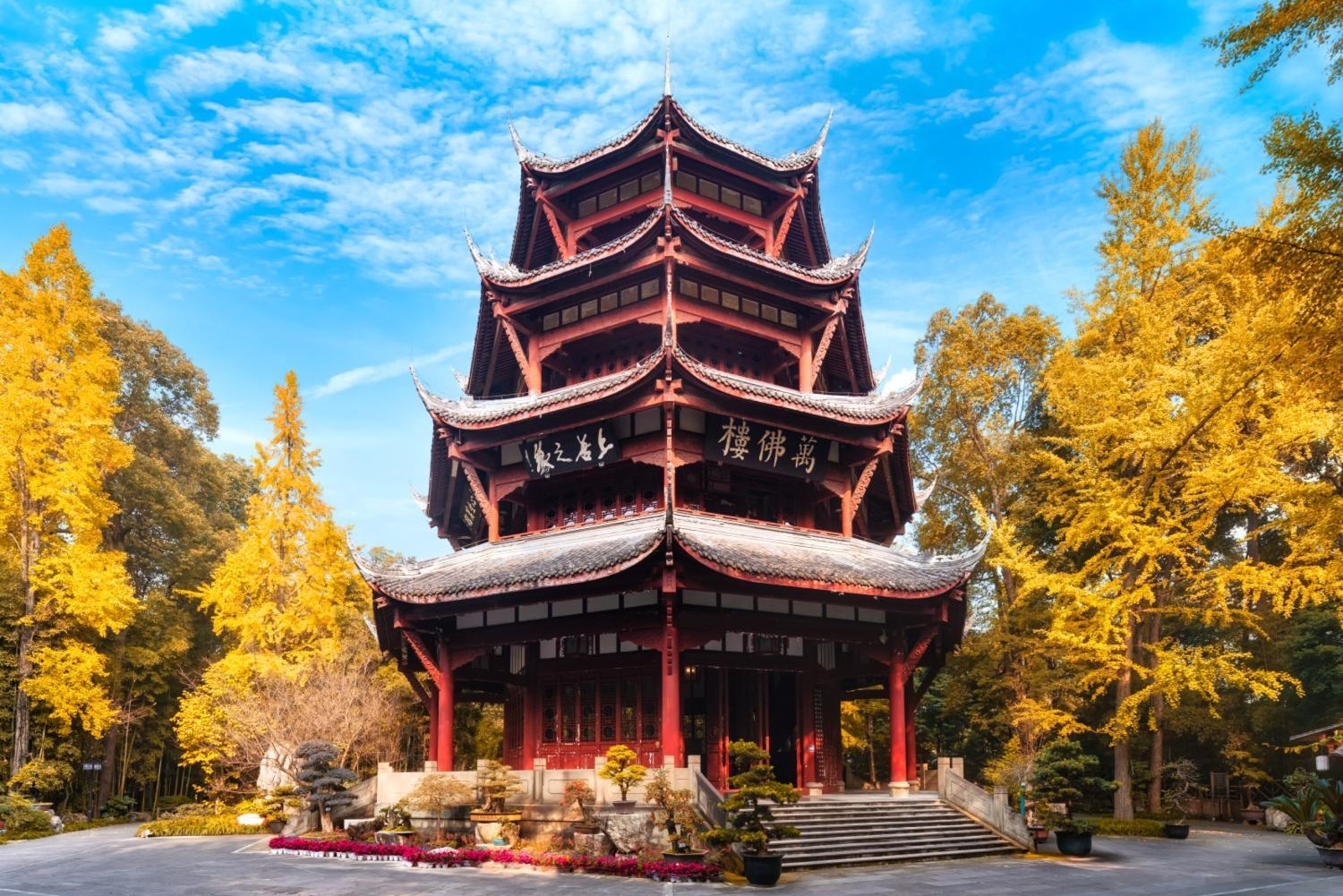
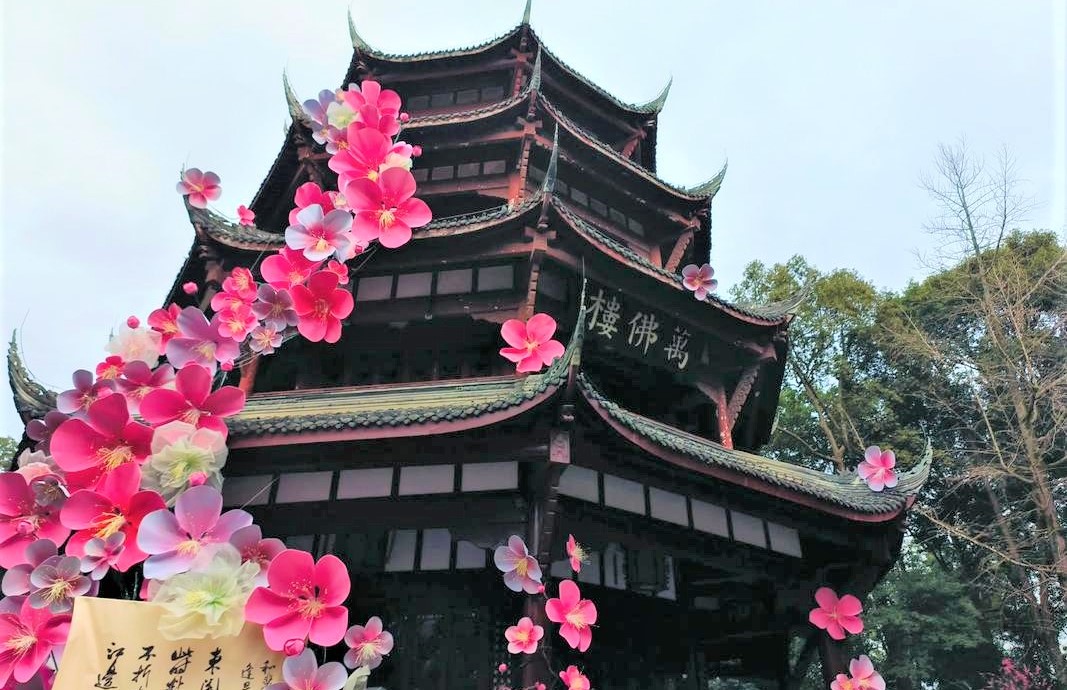
Wanfo Tower was rebuilt in 2005 on its original site. The original structure was a wooden, four-story, heavy-eaved, spire-shaped pagoda with a regular octagonal design. The roof was covered with glazed tiles, and inside, four mud statues of Buddhas were enshrined, with over a thousand Buddha images painted on the walls. It was a famous ancient building in Chengdu but was demolished during the "Cultural Revolution." The current reconstructed Wanfo Tower covers an area of 910 square meters and consists of four stories, standing at a height of 30.7 meters. It retains the original octagonal shape with four heavy eaves and includes a newly cast bronze bell, which is hung at the top of the tower. The rebuilt Wanfo Tower has revived the historical image of Chengdu, once known as "East has Chongli Pavilion, West has Wanfo Tower," and has become another iconic building and cultural tourism landmark of the Du Fu Thatched Cottage Museum.
12. Caotang Academy
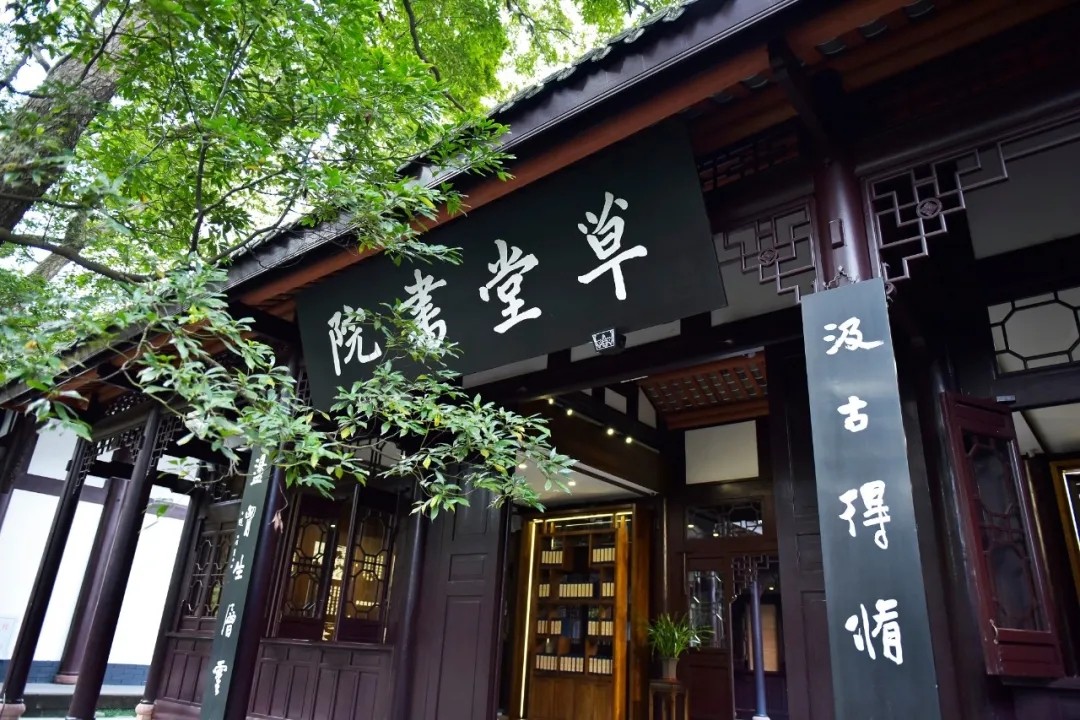
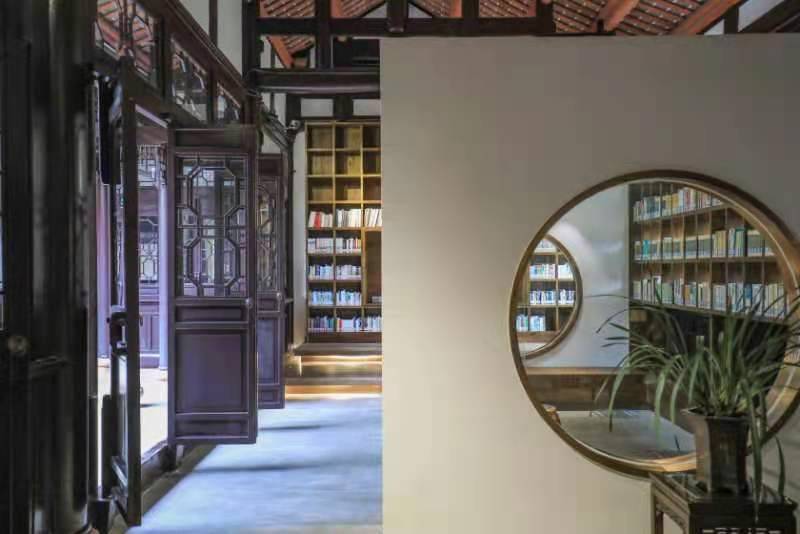
The Caotang Academy, founded in the Yuan Dynasty, was once one of Chengdu's three most famous academies. It grew in prominence during the Ming and Qing Dynasties but declined due to war. In 2017, the Chengdu Du Fu Thatched Cottage Museum began restoring the academy, and it officially opened in 2021. The academy spans 3,586 square meters and features two sections: a traditional Chinese four-courtyard building with spaces for culture, Chinese studies education, a library, and academic activities; and a modern academic lecture hall for large forums. Additionally, the standalone Yangzhi Hall serves as the children's academy, offering educational programs for minors.
13. Tang Dynasty Site
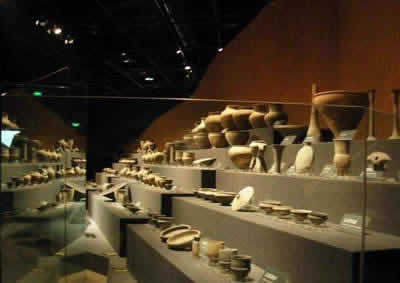
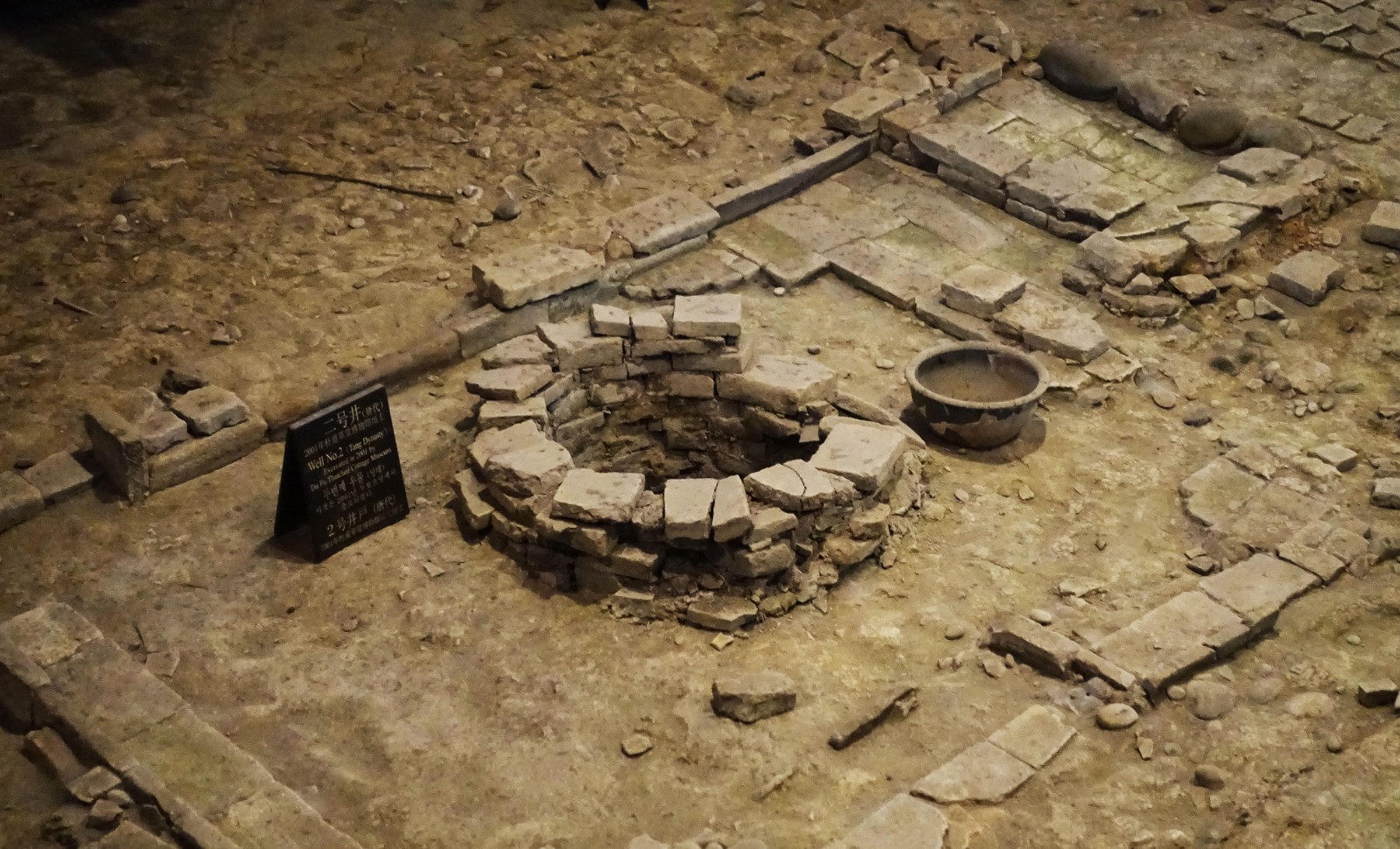
The Tang Dynasty Site Exhibition Hall in the north preserves a 420m2 archaeological site, where an abundance of utensils (both intact and damaged), dozens of Kaiyuan Tongbao currencies, and more importantly, relics revealing people’s life in the Tang Dynasty including three wells, eight house sites, one oven pit, five cellar pits, nine ash pits and four ditches were unearthed. From the excavation site that proves structures here were mostly built with materials abandoned from old temples and covered with thatched roofs, we can infer that residents here must be grassroots civilians. As recounted in Du Fu’s poems, this was a rural neighborhood of farmers, fishermen and countrymen. Therefore, the living conditions presented here are exactly as described in his poems.

Garden Scenic Area
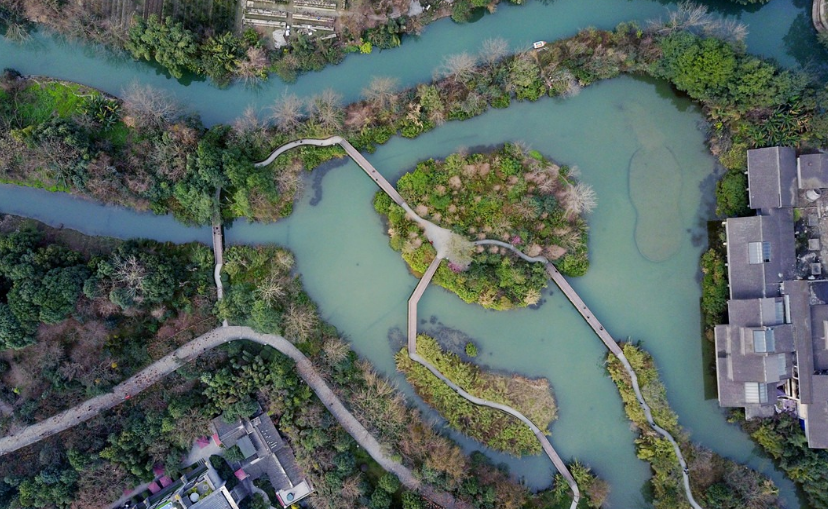
The Huan Huaxi Park is the core area of the Huan Huaxi historical and cultural scenic zone, covering 444.8 acres. It is the largest open urban park within Chengdu’s second ring road. The park is divided into three main themed areas: Wanshu Mountain, Canglang Lake, and Egret Island. Its landscape features include a man-made mountain, an artificial lake, an urban wetland, two landscape buildings, the China Poetry Culture Center, and the Du Fu Thousand Poetry Monument, completed in 2018.
 2 Days Chengdu Tour: Blending Modern & Ancient Heritage
 Chengdu Delights: A 3-Day Journey of Culture, Pandas & Sichuan Flavors
How to Get to Du Fu Thatched Cottage
1. Self-Driving and Parking Guide
The Chengdu Du Fu Thatched Cottage Museum has underground professional parking lots at both the South and North gates.
· South Gate Parking: Located at No. 2 Caotang Road, the underground parking lot has 300 parking spaces for regular cars, with 12 spaces designated for tourist buses.
· North Gate Parking: Located at No. 37 Qinghua Road, the underground parking lot has 200 parking spaces for regular cars.
Parking Time: 24-hour parking is available.
2. Public Transportation Routes Around Chengdu Du Fu Thatched Cottage Museum
For inquiries, please call the public transportation hotline: +86-028-85076868.
There are many city bus routes that can take you to the Du Fu Thatched Cottage museum, including: Bus Routes 19, 35, 58, 82, 151, 165, 170, 1024, 1031. Additionally, the BRT (Bus Rapid Transit) on the Second Ring Road and Metro Lines 2 and 4 all reach the vicinity of the museum! The Du Fu Thatched Cottage Museum also offers its own tourist routes, which include:
· Du Fu Thatched Cottage — Wuhou Shrine
· Du Fu Thatched Cottage — Jinsha Site
· Du Fu Thatched Cottage — Yongling Tomb
3. Community Bus
· 1024 Route (Loop Line 7:00-21:00)
· 1031 Route (Loop Line 7:00-21:00)
4. Metro:
· Metro Line 4: Please get off at Caotang North Road Station and walk to No. 37 Qinghua Road (North Gate of Caotang).
· Metro Line 5: Please get off at Qingyang Palace Station and walk to No. 37 Qinghua Road (North Gate of Caotang).
5. Second Ring BRT:
· Please get off at Guanghua Village Intersection, then walk to No. 28 Caotang Road (Main Gate of Caotang), or transfer to another bus route to No. 37 Qinghua Road (North Gate of Caotang).
Practical Visitor Information
1. Address: No.37, Qinghua Road, Qingyang District, Chengdu, Sichuan, China
2. Opening Hours
· Jan 1–Jun 30 every year: 9:00 AM–6:00 PM (Tickets available until:5:00 PM)
· Jul 1–Aug 31 every year: 8:30 AM–6:30 PM (Tickets available until:5:30 PM)
· Sep 1–Dec 31 every year: 9:00 AM–6:00 PM (Tickets available until:5:00 PM)
3. Ticket Information
· Adult Ticket: The ticket price also varies by season. In peak season (April-October), the adult ticket costs 50 RMB; in off-season (November-March), it’s 40 RMB.
· Discounts: There are several discount policies available. Children under 1.3 meters in height can enter for free when accompanied by an adult. Seniors aged 65 and above with a valid ID card, disabled visitors with a disability certificate, and active-duty soldiers with a military ID are also entitled to free admission. Students with a valid student ID (including international students) can purchase a discounted ticket for 25 RMB.
· Booking: You can buy tickets in two ways. Online booking is convenient and recommended to avoid long lines—you can purchase tickets through the museum’s official WeChat account, major travel platforms like Ctrip or Fliggy, or the official website. On-site tickets are available at the ticket windows near the east and west gates, which accept cash, Alipay, and WeChat Pay.
4. Free Stroller and Wheelchair Rental Guidelines
· Free rental hours: 9:00 AM-5:30 PM.
· Free stroller and wheelchair rentals require a deposit of 300 RMB per unit and completion of the Tourist Center Registration Form for Stroller and Wheelchair Rentals.
· Strollers have a maximum weight capacity of 15kg and wheelchairs 90kg. For safety reasons, usage will be declined if weight exceeds these limits.
· The museum will assist visitors in checking the stroller or wheelchair for any issues, ensure it is in proper working condition, and obtain the user’s consent before renting it out.
· During the rental period, visitors are responsible for safekeeping the strollers or wheelchairs. In case of loss, please contact the staff immediately (+86-028-68921800; +86-028-87327392). If the items cannot be recovered, compensation based on the full price will be required. Staff will provide a copy of the invoice for the stroller or wheelchair, and a resolution will be negotiated at no less than 50% of the invoice amount.
After the rental is completed, the museum will inspect the item’s condition before the visitors. If everything is in order, the deposit will be refunded.
5. Guided Tours
· Instructor Photos
Interpretation time: 9:00 AM-5:00 PM
Hotline for reservations, consultations, and feedbacks: +86-028-87077705
Price reporting hotline: +86-12358
· Interpretation rates
Interpretation for individual visitors
Language | Interpretation Type | Rates | Participant Limit | Interpretation Time |
Chinese | General | 120 RMB/Interpretation | 1-3 Persons/Interpretation | About 1 Hour |
40 RMB/Person-time | 4-20 Persons/Interpretation |
Sub-senior Expert | 800 RMB/Interpretation | =20 Persons/Interpretation |
Senior Expert | 1,000 RMB/Interpretation |
Foreign Languages | General | 180 RMB/Interpretation | 1-3 Persons/Interpretation |
60 RMB/Person-time | 4—20 Persons/Interpretation |
* Note: Expert interpretation should be reserved 1 week in advance.
Regular interpretation
Language | Standard Fee | Schedule | Participant Limit | Interpretation Time |
Chinese | 20 RMB/Person-time | See the Bulletin at Site | =20 Persons/Interpretation | About 1 Hour |
* Note: A deposit of 100 RMB will be charged for each individual booking an interpretation session. The deposit receipt is used to return the deposit and should not be discarded. When the interpretation is over, you can receive your deposit from the instructor with your receipt and receiver returned. If the receiver is lost or damaged, compensation shall be made based on the cost. (Compensation: 200 RMB/interpretation receiver)
· Smart Guidance
Official WeChat Account (free of charge): Chinese, English
* Notice for use: Follow the Official WeChat Account “dfctbwg”, click “Tour Guide” at the left bottom - “Audio Guide” and reply with the serial number for the attractions to get a complementary interpretation session.
· Mobile phone Guide
Language: Chinese, English, Japanese, Korean, French, German, Russian, Portuguese, Arabic
Version: Normal version, Student version, Academic version
Rates:
Chinese version 12 RMB/time; Student version 12 RMB/time
Academic version 16 RMB/time; Foreign Languages 18 RMB/time
* Notice for use: Open WeChat to scan the QR Code inside the museum, choose an interpretation service, pay the fee and then enjoy. Consultation number: 17743236632
· Self-service Audio Guide
Language: Chinese, English, Japanese, Korean, French, German, Russian, Portuguese, Arabic
Version: Normal version, Student version, Academic version
Rate: 25 RMB/device/time. Deposit: 200 RMB/device
* Notice for use: Scan the QR Code on the screen of the audio guide rental machine and pay a deposit to receive your device. The device can be returned at all machines in the museum after use.
Consultation number: 4000901168
Nearby Attractions
1. Qingyang Palace: Located just 1.5 km east of the cottage, Qingyang Palace is one of the oldest and most famous Taoist temples in China. Founded during the Western Jin Dynasty, it features ancient buildings like the Hall of the Jade Emperor and the Eight Trigrams Pavilion. The temple is also known for its stone ox statue, which is said to bring good luck if you touch it. It takes about 15 minutes to walk there from the cottage, or 5 minutes by taxi (costing around 10 RMB). The entrance fee is 10 RMB.
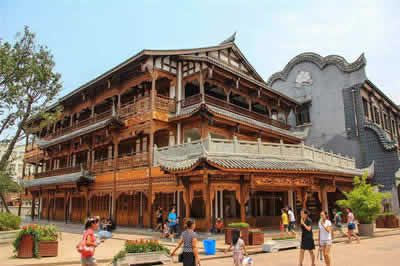
2. Jinli Ancient Street: Situated 3 km southeast of the cottage, Jinli is a bustling pedestrian street that recreates the look and feel of ancient Chengdu. It’s lined with traditional wooden shops selling snacks, handicrafts, and souvenirs. You can try local specialties like spicy rabbit head, sugar paintings, and dragon’s beard candy. There are also traditional performances like shadow puppetry and Sichuan opera. To get there, take a taxi (10-15 minutes, 15-20 RMB) or start from Du Fu Thatched Cottage Museum, walk 220 meters to reach Du Fu Thatched Cottage (North Gate) Bus Stop, then take Bus Route 82 and ride for 6 stops before getting off at Wuhou Temple Bus Stop, and finally walk 70 meters to arrive at Jinli Ancient Street. This route takes about 33 minutes in total, with the bus ride covering 4.4 kilometers and the total walking distance adding up to 280 meters, and the bus fare is 2 RMB.
3. Wuhou Temple: Adjacent to Jinli, Wuhou Temple is dedicated to Zhuge Liang, a famous strategist from the Three Kingdoms period. It’s a beautiful complex with ancient buildings, gardens, and stone tablets. The entrance fee is 50 RMB, and it’s a great place to learn about Three Kingdoms history.
 Local Tour in Chengdu: Discover the Authentic Chengdu Lifestyle
 One-Day Chengdu City Tour: Chengdu Panda Research Base, Jinli Ancient Street, and Kuanzhai Alley Exploration
Nearby Accommodation Options
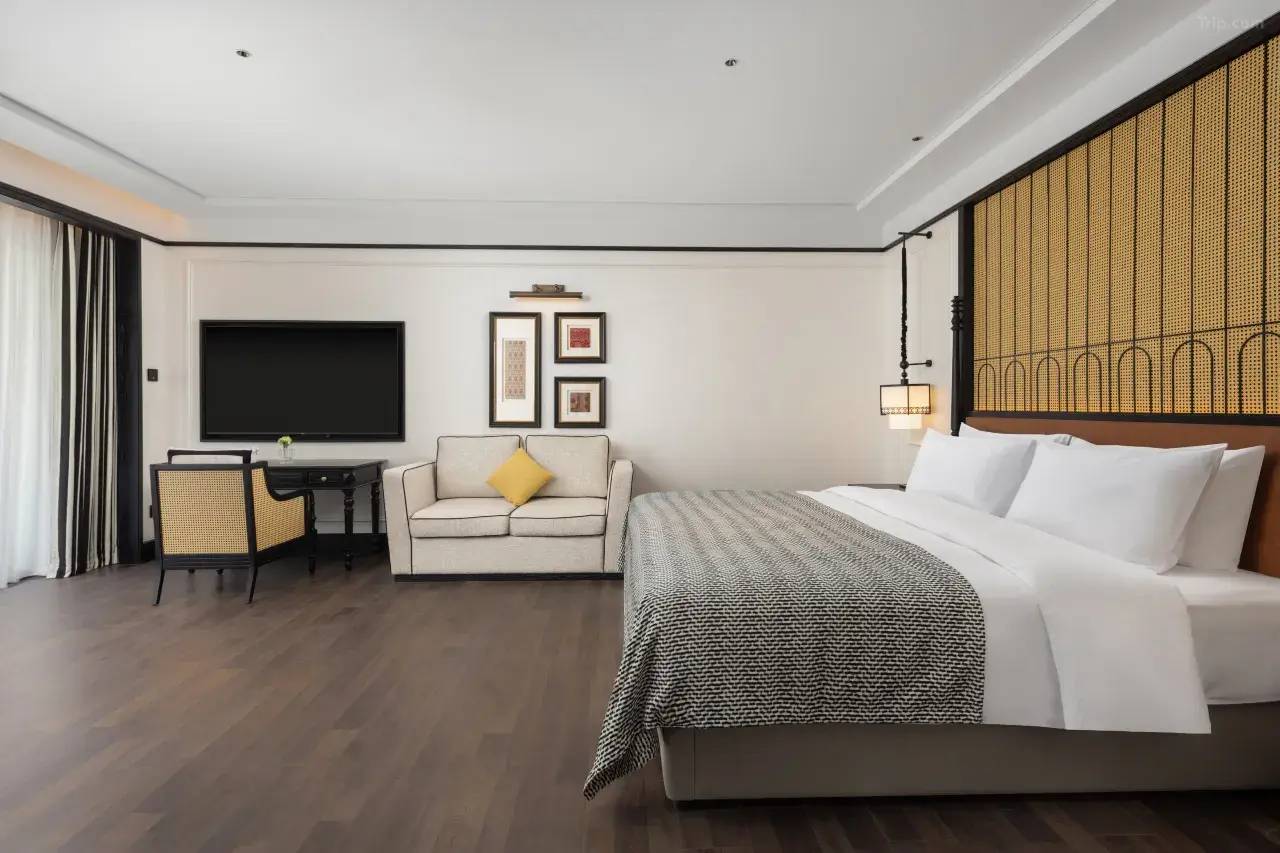
1. Blossom Manoir Du Fu Thatched Cottage

Address: No. 159 Caotang East Road, Qingyang District, Chengdu, Sichuan, China
Phone: +86-28-87777701
2. Manxin Mansion Chengdu Du Fu Thatched Cottage
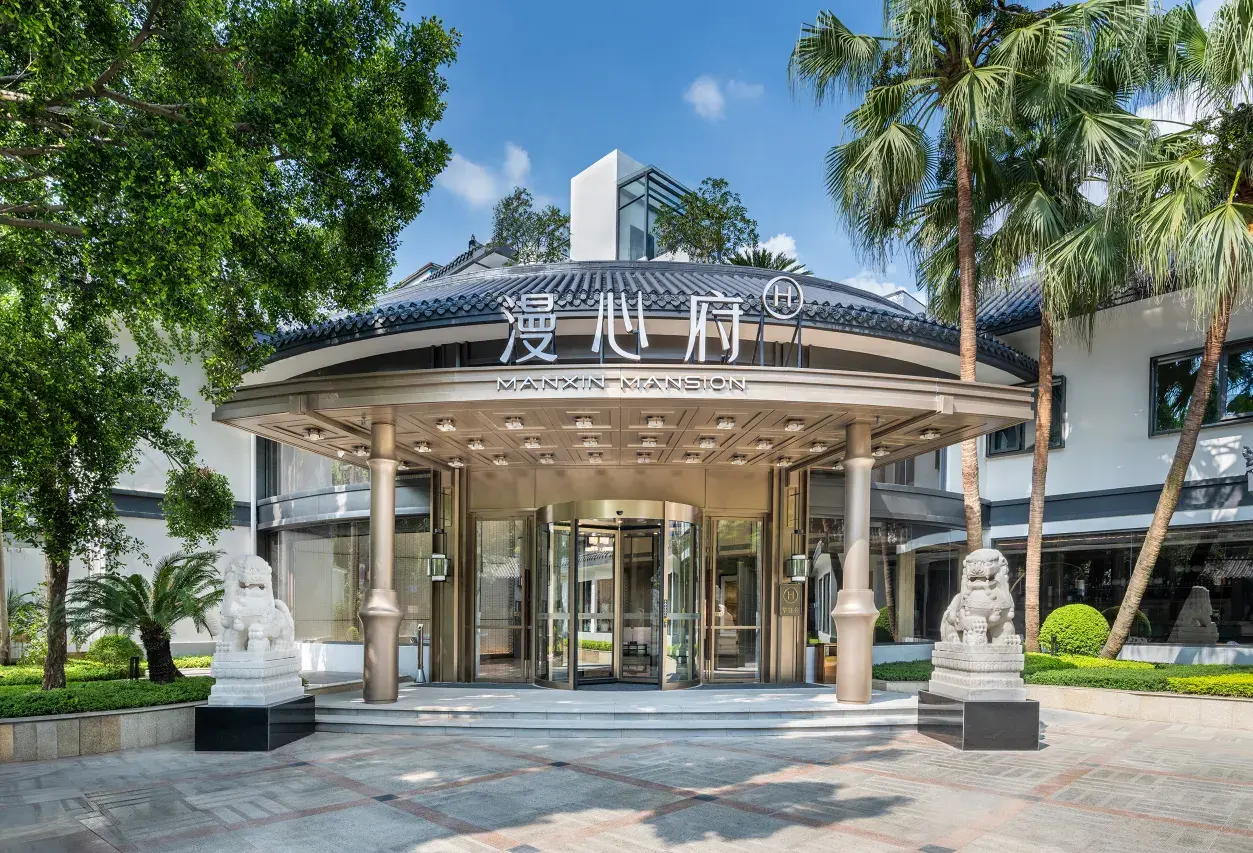

Address: No. 58 Caotang Road, Qingyang District, Chengdu, Sichuan, China
Phone: +86-28-87319988
3. Huanhua Hongtai Hotel
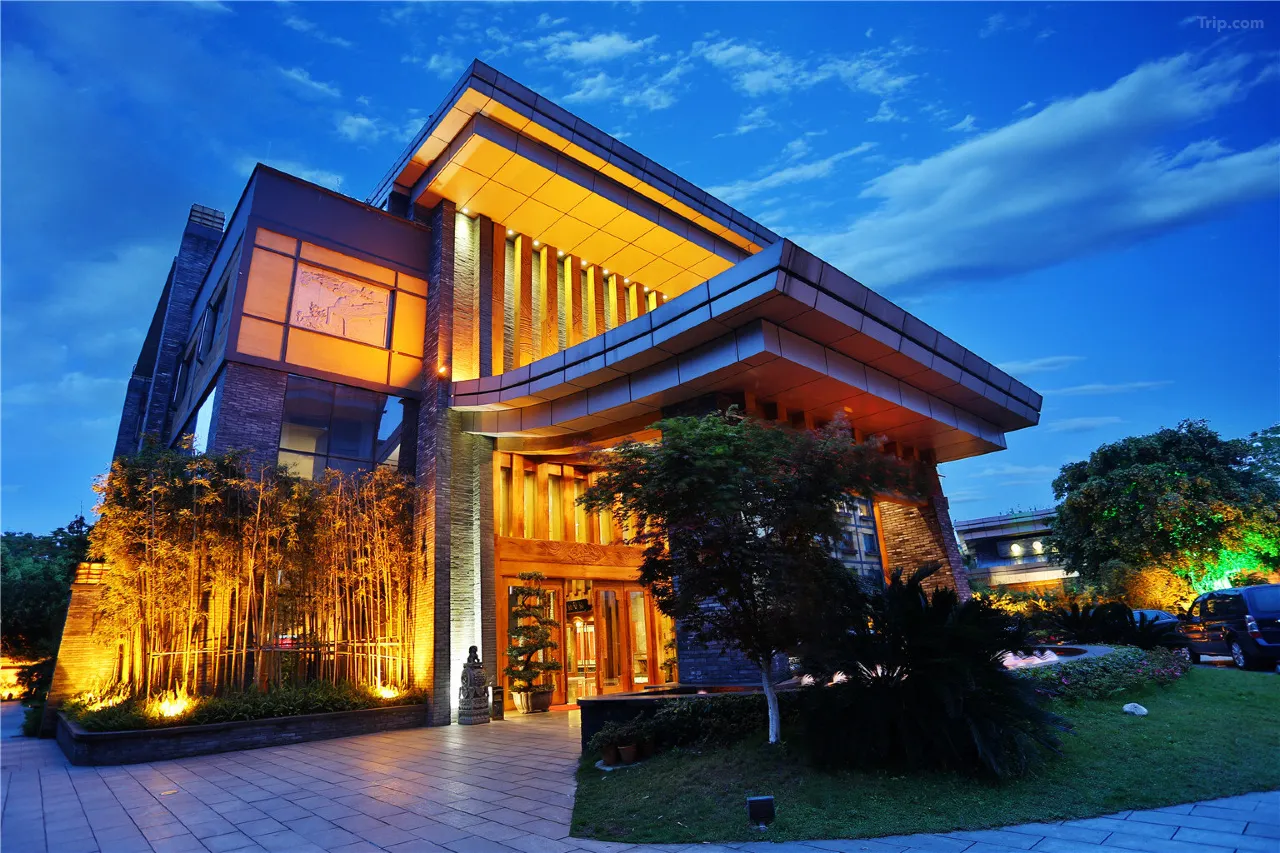
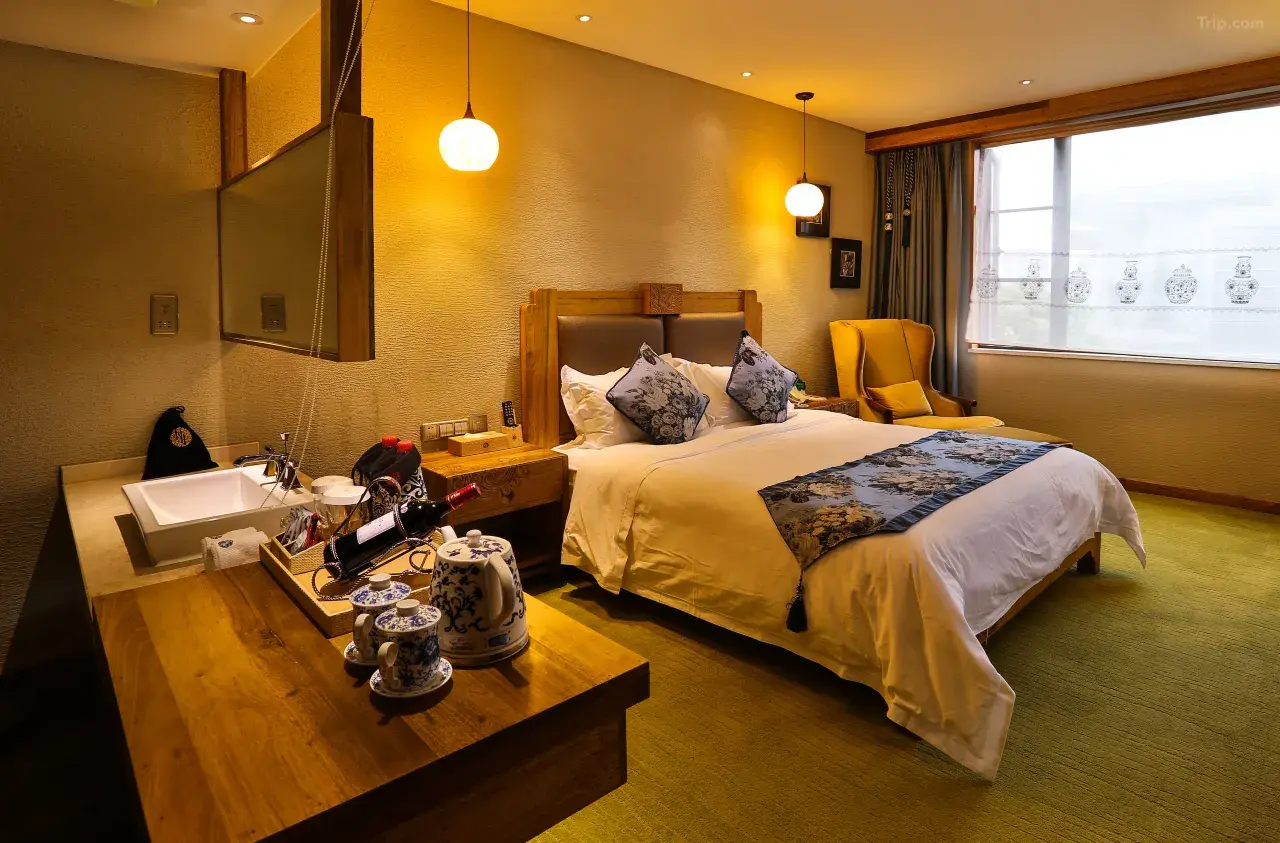
Address: No. 1 Attached, No. 251, Huanhua South Road, Qingyang District, Chengdu, Sichuan, China
Phone: +86-28-87319888
Useful Tips for Visitors
Tour Tips
1. Best Time to Visit: The best time to visit the cottage is early in the morning, between 9:00 AM and 11:00 AM. At this time, the crowds are smaller, the air is fresh, and the sunlight is soft—perfect for taking photos and enjoying the garden’s tranquility. Season-wise, spring (March-April) is beautiful, with cherry blossoms and azaleas blooming; autumn (October-November) is equally charming, with maple leaves turning red and osmanthus flowers fragrant. Avoid visiting on weekends and public holidays, as it can get very crowded.
2. Recommended Duration: Plan to spend 2-3 hours at the cottage. This gives you enough time to visit all the key attractions, watch the short film in the exhibition hall, and join a poetry recitation session or calligraphy experience. If you’re a literature enthusiast, you might want to spend an extra hour exploring the exhibition halls in detail.
3. Dress Code: Wear comfortable walking shoes, as you’ll be doing a lot of walking on stone paths and grassy areas. Avoid high heels or flip-flops, which can be slippery. In summer, wear lightweight and breathable clothing, and bring a hat and sunscreen—though the bamboo groves provide some shade. In winter, dress warmly, as the garden can be chilly in the morning and evening.
Cultural Etiquette Tips
1. Keep Quiet: The cottage is a place of cultural reverence, so please speak in a low voice, especially in Shishi Hall, the exhibition halls, and the thatched cottage. Avoid loud conversations or using your phone at full volume—this allows everyone to enjoy the peaceful atmosphere.
2. No Touching: Do not touch any artifacts, exhibits, or ancient buildings. Many of the items on display are fragile, and touching them could cause damage. In the calligraphy experience area, only touch the provided materials (paper, brush, ink) as instructed by the staff.
3. No Littering: Help keep the garden clean by disposing of trash in the designated bins. There are trash cans located near rest areas, toilets, and attractions. Do not pick flowers or break bamboo stalks—these are part of the cottage’s natural and cultural heritage.
4. Respect Photography Rules: Most areas of the cottage allow photography, but flash photography is prohibited in the exhibition halls to protect the artifacts. Some statues and ancient buildings may have signs prohibiting photography—please follow these rules.
Emergency Tips
1. Emergency Contact: The museum’s emergency phone number is +86-028-68921800. If you encounter any emergency, such as a medical issue or lost property, call this number immediately. There is a first-aid station near the east gate, staffed by trained medical personnel and equipped with basic medical supplies.
2. Lost & Found: If you lose an item during your visit, report it to the information desk at the east gate. The staff will log your lost item and contact you if it is found. You can also check the lost and found section on the museum’s official website.
3. Getting Lost: The cottage grounds are large, but there are maps posted at every intersection. If you get lost, ask any staff member (they wear red or blue uniforms) for help, or go to the nearest rest area or toilet, where you can find a map or ask for directions.
4. Weather Emergencies: In case of heavy rain or thunderstorms, seek shelter in the nearest pavilion, exhibition hall, or rest area. Do not stand under trees or near tall bamboo stalks, as they can be struck by lightning. The museum will announce weather warnings over the loudspeaker if necessary.
Visiting Du Fu Thatched Cottage is not only a profound experience of Du Fu’s poetry but also a unique appreciation of ancient Chinese culture and natural beauty. From the ancient architecture of the cottage to the poetic gardens, every corner is filled with rich historical and cultural significance. Here, you can step into the world of Du Fu and feel the depth of his insights into nature and humanity. Whether you're a history enthusiast, a literature lover, or someone seeking tranquility, Du Fu Thatched Cottage offers an unforgettable cultural journey.
Your Way Holiday’s In-Depth Guide to Chengdu’s Du Fu Thatched Cottage and the Best Local Attractions
We design private and tailor-made Chengdu tours customized to your travel style at affordable local prices. You’ll enjoy the comfort of a private, spacious car and the company of a professional local guide with over 5 years of experience, dedicated exclusively to you or your group. From transportation and tickets to authentic dining experiences (we always recommend the dishes most loved by locals), everything will be arranged according to your preferences. Please take a look at some of our most popular Chengdu tours below:
 Private Half Day Chengdu Modern Architecture Sightseeing Tour
 Chengdu Night Sightseeing Tour with Jinjiang River Cruise & Bar Street
Not exactly what you’re looking for? Don’t worry — all of our Chengdu tours can be fully customized based on your interests, schedule, and budget. We specialize in creating unique Chengdu experiences that go beyond the guidebook, giving you the chance to truly connect with the local culture and people. Our enthusiastic tour experts are always ready to provide detailed suggestions and will respond to your inquiry within 24 hours. Ready to explore Chengdu your way? Contact us today and let us design a Chengdu shopping experience that fits your style. Your Way Holiday looks forward to your message! We're ready to design an unforgettable Chengdu trip for you anytime.