24 Hours Hotline: +8613735411378
Email:[email protected]
24 Hours Hotline: +8613735411378
Email:[email protected]

Great Hall of the People, Chongqing Attraction
Introdution
The Great Hall of the People, also translated as the Chongqing People's Auditorium. It is a large hall for political meetings and cultural events and serves as one of the architectural symbols of Chongqing. The exterior resembles the Temple of Heaven in Beijing.
The Great Hall of the People has ranked as the Top 10 Classic Asian Architecture of the 20th Century and the Classic Chinese Centennial Building of the 20th Century. It will lead you truly understand how splendid and magnificent it is without a stroll in this 65-year-old building and a firm grasp of its construction history.
Construction
A classic Chinese centennial building
Situated in Yuzhong District, the great hall is not only a calling
card of Chongqing but also one of the most magnificent auditoriums after
the founding of the People’s Republic of China. Mr. Liang Sicheng, a
leading authority in Chinese architecture, called it “the most classic
building of epoch-making Chinese classical architecture in the 1950s”.
In 1987, Royal Institute of British Architects, together with University of London, completed the History of World Architecture. This authoritative book, for the first time, included 43 projects built after the founding of the PRC, among which the auditorium ranked second. Listed into the seventh batch of major cultural sites protected at the national level (often abbreviated as guobao) in 2013, it becomes the youngest “guobao” in Chongqing. Meanwhile, it is also one of the 98 projects selected into the “First Batch of the 20th-Century Chinese Architectural Heritage” released by Chinese Society of Cultural Relics and Architectural Society of China in 2016.
Winning Zhan Tianyou Civil Engineering Award and Luban Award, the auditorium has also enjoyed the title of “Top 10 Buildings Since 1949”.
This ancient-style national architectural complex is also an important venue for Chongqing’s cultural exchange with foreign countries. Additionally, it has witnessed various large gatherings and performances, as well as significant and international conferences including Chongqing’s congress of party representatives, people’s congress, people’s political consultative conference, and the unveiling. Piano Prince Richard Clayderman, Dolphin Sound Prince Vitas, Cai Qin, Qi Qin, and Mo Wenwei, such foreign and Chinese celebrities have performed there.

Served foreign VIPs in the past
The construction began in June 1951, and the main part completed in
January 1954. This auditorium opened in April 1954, when Chongqing was
the capital of Administrative Region of Southwest China after
liberation.
The newly-built auditorium received a delegation of over 100 people from the Democratic People’s Republic of Korea or DPRK, who were the first group of foreign guests visiting there.
As the third splendid Oriental architecture after Imperial Palaces of the Ming and Qing Dynasties in Beijing and Shenyang, it has won unanimous praise from experts of former-Soviet states which supported the economic construction of Southwest China. The foreign delegations would choose this auditorium as their accommodation in Chongqing, and considered it as an honor.
260,000 gold flakes make the roof more resplendent
For better protection and utilization, the auditorium, before going
into service, has formulated the principle of minor repair for five
years and general reconstruction for a decade. The first day of August
2006 saw the largest maintenance since its completion.
As the supporting timber structure has been rotten and worm-eaten, the maintenance personnel tore down the whole roof. Glazed tiles, instead of roofing tiles, cover the roof for a better restoration. Each metal, made from different formulas and weighed on the balance, aims for the color of peacock blue close to the original. The pillar adopts the golden-dragon Hexi painting, with the meaning of “peace and favorable weather”. This pattern represents the highest level of decorating Chinese imperial architecture in the Qing Dynasty (1644–1911). The gold foil with the gold content up to 98% is used on the pillar, capital, bucket arch, and sparrow brace. The bright and durable color matches the lacquer in dark blue, dark green and scarlet, looking more resplendent.
In May 2007, this auditorium completed its nine-month restoration, with a total investment of RMB 81,256,300. The indoor top consists of 260,000 gold flakes, each worth RMB 10.
Information
Admission Fee: CNY 10
Address: No. 173, Renmin Road, Yuzhong District, Chongqing
How to get there: Take city bus No. 112, 145, 152, 181, 262, 322, 338, 421, 457, 829 and get off at Dalitang station.
Duration:6-8 Hours
Attractions(Cities): Chengdu Panda Research Base, People's Park, Jinli Ancient Street, Kuanzhai Alley
Tour Style:One day, one private car, and an English-speaking local guide who has already booked every ticket on the list. Mornings start early at the Chengdu Research Base of Giant Panda Breeding so you catch the pandas while they are still active; after that, the pace slows to a hillside teahouse in Renmin Park, gaiwan jasmine tea in hand. Between the two you walk Jinli's lantern-lit lane and finish in Kuanzhai Alley, where restored Qing courtyards now sit alongside small shops and tea rooms. Pick-up and drop-off match your schedule — a Chengdu hotel, a train station, or the airport.
Duration:8 Hours
Attractions(Cities):Chengdu Giant Panda Research Base, Leshan Giant Buddha
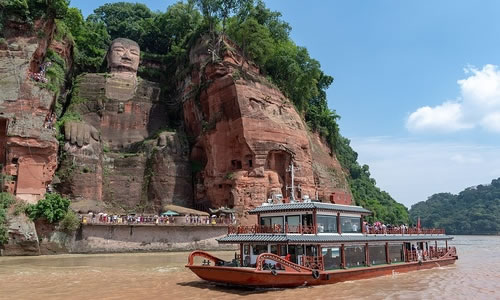
Tour Style:Two UNESCO-listed sights on one private day out of Chengdu. The morning starts at the Chengdu Research Base of Giant Panda Breeding while the animals are still active in the cool hours, then the driver takes you south along the expressway to Leshan, where a 71-metre stone Buddha carved between 713 and 803 AD still stands at the junction of three rivers. Walk the Nine Bends Plank Road, take the river boat, or do both. English-speaking local guide, private air-conditioned car with an experienced driver, Panda Base and Leshan tickets included, hotel, train station, or airport pick-up.
Duration:2 Days, 1 Night
Attractions(Cities):Chengdu Panda Base, Renmin Park, Wuhou Temple, Jinli Street, Wenshu Monastery, Chengdu Museum, Tianfu Square
Tour Style:This two-day private tour moves between the old and new faces of Chengdu at your own pace. Day 1 starts at the Chengdu Research Base of Giant Panda Breeding in the morning, when the pandas are feeding, then takes in the teahouse scene at Renmin Park, the Three Kingdoms shrines of Wuhou Temple, and the snack stalls and craft shops of Jinli Ancient Street. Day 2 covers the Buddhist halls of Wenshu Monastery, the collections of the Chengdu Museum, and the modern plaza at Tianfu Square. A private car and an English-speaking guide carry you between all of them, with pickup from your hotel, train station, or the airport, and the daily order flexes if you want longer at the panda base or a slower teahouse stop. Lunch is left open so your guide can point you to local kitchens rather than tourist menus.
Duration:8-9 Hours
Attractions(Cities):Dujiangyan, Qingcheng Mountain
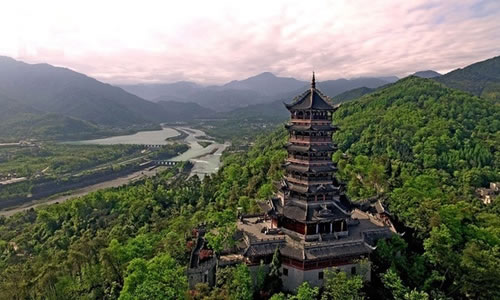
Tour Style:This day trip pairs two UNESCO-listed sights west of Chengdu: the Dujiangyan Irrigation System and Qingcheng Mountain. A private car and driver collect you from your hotel, train station, or the airport and stop first at Dujiangyan, where an English-speaking guide walks you through the 256 BC waterworks that Li Bing and his son built without a dam, still carrying Min River water onto the Chengdu plain after more than 2,000 years. You see the Fish Mouth levee, Flying Sand Reef, and Bottle Neck channel up close. After lunch you drive to Qingcheng Mountain, a founding site of Taoism, and take the cable car and stone paths past the front-mountain temples. Lunch is left out on purpose so your guide can point you to a local Sichuan kitchen; pace, photo stops, and vegetarian or lighter requests are easy to adjust on a private tour.
Duration:3 Days 2 Nights
Attractions(Cities):Leshan Giant Buddha, Mount Emei, Chengdu Research Base of Giant Panda Breeding, Renmin Park, Jinli Ancient Street, Kuanzhai Alley
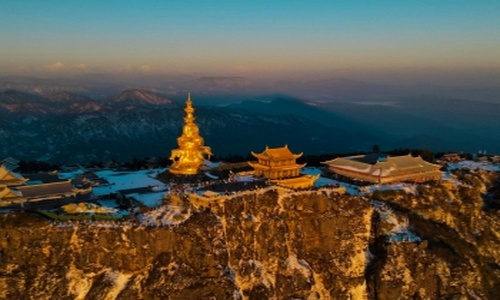
Tour Style:This three-day private tour pairs Chengdu with two mountain and heritage sights. Day one covers the Giant Panda Breeding Research Base in the morning, then Renmin Park teahouse, Jinli Ancient Street, and Kuanzhai Alley. Day two drives about two hours to the 71-metre Leshan Giant Buddha, seen from the cliff path or a Dadu River boat, then on to an overnight at the foot of Mount Emei. Day three rises by eco-bus and cable car to the Golden Summit at 3,077 metres and the old temples before the return to Chengdu. A private car, driver, and English-speaking guide handle tickets and transfers, and pick-up and drop-off run from your Chengdu hotel, station, or airport.
Wechat: YourWayHolidayAsia
24 Hours Hotline:
+8613735411378
Certificate of Excellence
2012~2026

Your Way Holiday
(Your Privacy is Protected)
1 to 1 tailor-made service from our professional travel advisors for the most sophisticated
Constantly excellent reviews for attraction, hotel and service Competitive price
Local experts provide quality tours Best selected knowledgeable local guides Authentic local restaurants
7*24 hours available to create you a worry-free tour. No Hidden Fees and absolutely no pressure to buy. Secured