Exploring the Leshan Giant Buddha: A Complete Guide to China’s Most Majestic Ancient Sculpture
The Leshan Giant Buddha is not only a colossal stone statue but also a breathtaking cultural and spiritual landmark. A UNESCO World Heritage Site, the Leshan Giant Buddha represents centuries of history, artistic mastery, and Buddhist devotion. Visitors from around the globe come to witness the grandeur of this ancient marvel, and in this guide, we’ll walk you through everything you need to know for an unforgettable visit.
 Chengdu Panda Base & Leshan Giant Buddha Day Tour
 3 Days Chengdu Tour with Leshan Giant Buddha & Mount Emei
Overview
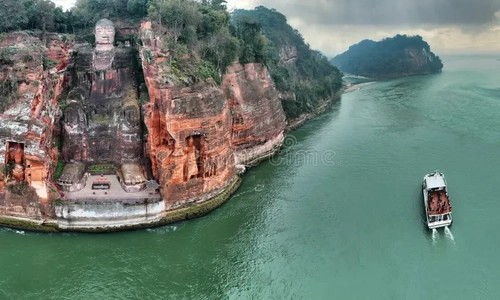
The Leshan Giant Buddha is located at the southern foot of Qiluan Peak, Lingyun Mountain, Shizhong District, Leshan City, Sichuan Province, in the golden zone where three rivers converge. Its construction began in the first year of Kaiyuan in the Tang Dynasty (713 AD), initiated by the eminent monk Master Haitong, and later continued by officials such as Zhangqiu Jianqiong and Wei Gao. It took more than 90 years to complete until the 19th year of Zhenyuan (803 AD). This giant Maitreya sitting statue is 71 meters tall, 24 meters wide at the shoulders, 14.7 meters tall at the head, and 7 meters long at the ears. More than a hundred people can sit around the instep, making it worthy of the title of "the world’s largest stone-carved Maitreya sitting statue." In 1996, the Leshan Giant Buddha and Mount Emei were jointly listed in the UNESCO World Heritage List. The review committee commented that it "shows the superb stone carving art level of the Tang Dynasty, and is perfectly integrated with natural landscapes, with irreplaceable cultural and natural values." As another Buddhist art treasure besides China’s four major grottoes, it is also a landmark landscape of Bashu culture and has become the most representative cultural symbol under the international cognitive label of "leshan giant buddha china."
Introduction to Core Attractions
1. Leshan Giant Buddha Main Body
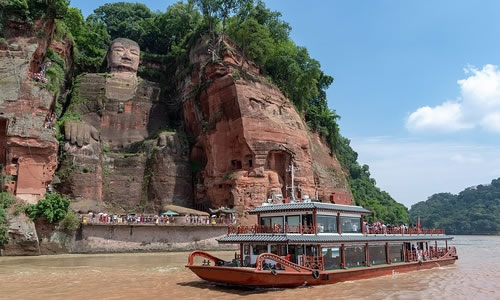
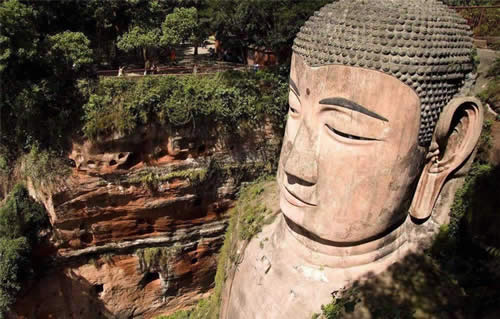
The Leshan Giant Buddha is the core landscape of the scenic spot. It is chiseled on the cliff facing the river of Qiluan Peak, Lingyun Mountain, as a sitting statue of Maitreya Buddha, and is the largest existing stone-carved Buddha statue in the world. The Buddha statue is 71 meters high, with a head height of 14.7 meters, head width of 10 meters, shoulder width of 24 meters, ear length of 7 meters, nose length of 5.6 meters, eyebrow length of 5.6 meters, mouth and eye length of 3.3 meters, neck height of 3 meters, finger length of 8.3 meters, and instep width of 8.5 meters, which can seat more than 100 people around.
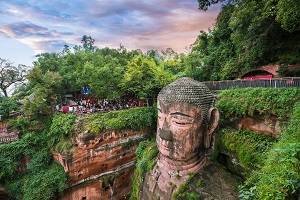
The Giant Buddha has a solemn and kind shape, with a plump facial expression, eyebrows like curved moons, eyes full of compassion, a straight nose, and slightly upturned mouth corners. There are 1051 spiral buns on the head, each carefully carved with clear textures; it wears a double-collar drooping cassock, with natural and smooth folds extending from the shoulders to the feet, as if fluttering in the wind. There is Lingyun Plank Road on the left side of the Buddha statue and Jiuqu Plank Road on the right side. Along the plank road, you can watch the details of the Giant Buddha up close: the drainage holes in the head buns, the hidden ditches at the collar, and the drainage system at the chest, all of which are the crystallization of the wisdom of ancient craftsmen. Standing at the feet of the Giant Buddha and looking up, the Buddha statue stands tall and majestic, integrating with the magnificent river scenery of the three rivers converging, which is breathtaking.


2. Lingyun Temple
Lingyun Temple is located at the foot of Qiluan Peak, Lingyun Mountain, adjacent to the Leshan Giant Buddha. It is an ancient temple built in the Tang Dynasty at the same time as the Giant Buddha, and is known as "the largest temple in Shu." Founded during the Kaiyuan period of the Tang Dynasty, the temple got its name because "the mountain has the potential of soaring into the clouds, and the temple deserves the name of Lingyun." It has been destroyed and rebuilt many times in history, and the existing buildings were rebuilt during the Ming and Qing dynasties.
Lingyun Temple is a three-courtyard complex consisting of the Heavenly Kings Hall, Mahavira Hall, and Scripture Collection Building, featuring red walls, green tiles, and shaded by lush trees. In front of the Heavenly Kings Hall stand towering ancient nanmu trees, with four Ming and Qing dynasty steles recording temple renovations flanking the hall’s exterior; inside, a Maitreya statue (commonly called the "Big-Bellied Arhat") sits in the center, flanked by four imposing Heavenly Kings statues, while behind the hall lies the Wei Tuo Hall housing a gilded wooden statue of the guardian deity Wei Tuo. Beyond the Heavenly Kings Hall is the Ming-dynasty Mahavira Hall, the main venue for religious activities, where a three-form statue of Sakyamuni (Dharma body, Manifested body, Reward body) sits solemnly in the center, surrounded by 18 lifelike arhats of distinct appearances; on the hall’s back wall stands a newly sculpted Guanyin with a vase, flanked by four Bodhisattva statues (Manjushri, Samantabhadra, Ksitigarbha, and Mahasthamaprapta) dating from before the Ming Dynasty. The temple’s last hall is the 1930-built Scripture Collection Building, which blends modern architectural styles for a unique charm and originally stored Buddhist scriptures; its ground floor houses the newly established "Hai Shi Hall," displaying full-body statues of Monk Haitong (the Giant Buddha’s builder), Zhangqiu Jianqiong, and Wei Gao to honor their contributions.


3. Jiuqu Plank Road
Jiuqu Plank Road is the only way to the foot of the Giant Buddha. It is located on the cliff on the right side of the Giant Buddha and gets its name because the plank road is winding and has nine bends. Founded in the Tang Dynasty, the plank road was chiseled at the same time as the Giant Buddha, with a total length of about 500 meters, the narrowest part is only 0.6 meters, with 217 steps, steep slope, and some sections are almost vertical.
Going down along the Jiuqu Plank Road, tourists need to hold the iron chain on the rock wall and move forward slowly. Along the way, they can watch the body and facial details of the Giant Buddha from different heights and angles: when passing the ears of the Giant Buddha, they can feel the shock of the 7-meter-long ears up close; when reaching the shoulder position, they can clearly see the fold texture of the cassock; when approaching the feet, the majestic momentum of looking up at the Giant Buddha is stronger. There are also Tang Dynasty cliff carvings on the rock walls on both sides of the plank road, with more than 200 small Buddha statues, unified in style with the Giant Buddha, and the themes are mostly Buddhist stories. There are many tourists on the plank road during peak season, so you need to abide by the "one-way traffic" rule, and off-peak tour experience is better.


4. Mahao Cliff Tomb Museum
Mahao Cliff Tomb Museum is located on the bank of Maohao Creek between Lingyun Mountain and Wuyou Mountain. It is China’s first special museum of Han Dynasty cliff tombs, built relying on the national key cultural relics protection unit "Mahao Cliff Tombs." Mahao Cliff Tombs are large-scale cliff tomb groups from the Eastern Han Dynasty (25-220 AD), with a total of 544 cliff tombs distributed on the cliff wall about 2000 meters long from east to west and 250 meters wide from north to south, which is a concentrated embodiment of the Han Dynasty funeral culture in the Bashu region.
The museum exhibits various cultural relics unearthed from cliff tombs, including pottery figurines, pottery horses, bronze ware, iron ware, jade ware, etc. Among them, "Han Dynasty dance and music figurines" and "breastfeeding figurines" are vividly shaped, showing the living scenes of the Han Dynasty; the "Jing Ke Assassinating Qin King" stone relief and "chariot and horse travel" brick relief have extremely high historical and artistic value. The museum also retains many well-preserved cliff tombs, such as "No. 1 Cliff Tomb" (commonly known as "Nine-Room Tomb"), which has a front room, middle room, back room and side rooms, with a complex structure. The tomb walls are carved with patterns of chariots and horses, music and dance, acrobatics, etc., which are important physical materials for studying Han Dynasty architecture, painting and folk customs. Visiting Mahao Cliff Tomb Museum allows tourists to deeply understand the social style of the Bashu region in the Han Dynasty while appreciating the Giant Buddha.


5. Oriental Buddha Capital
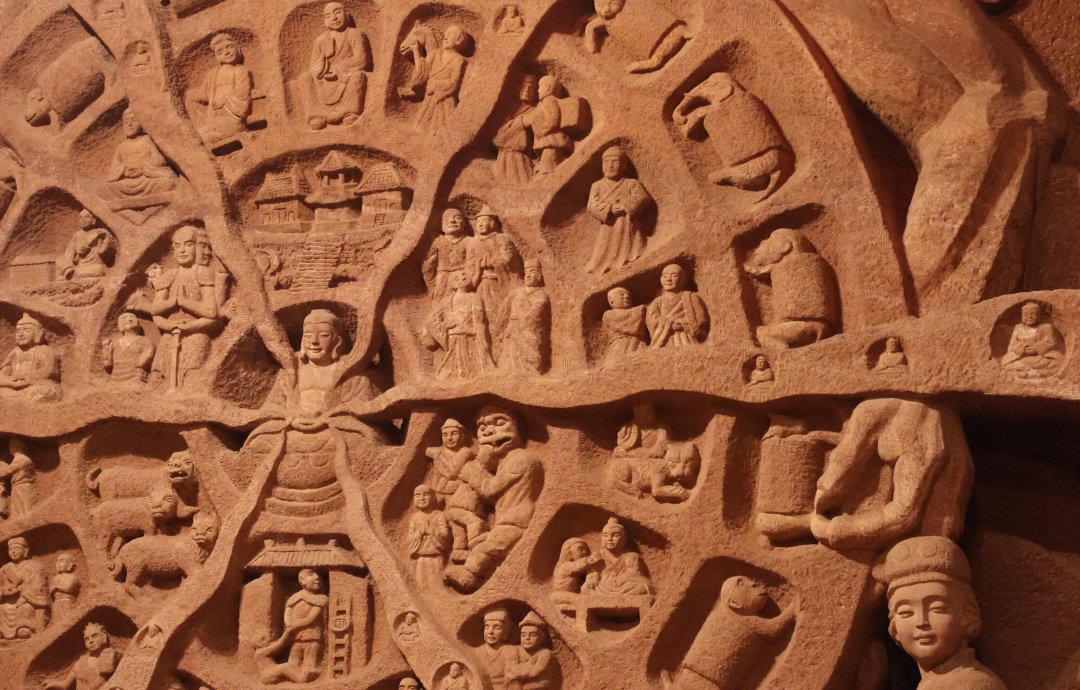
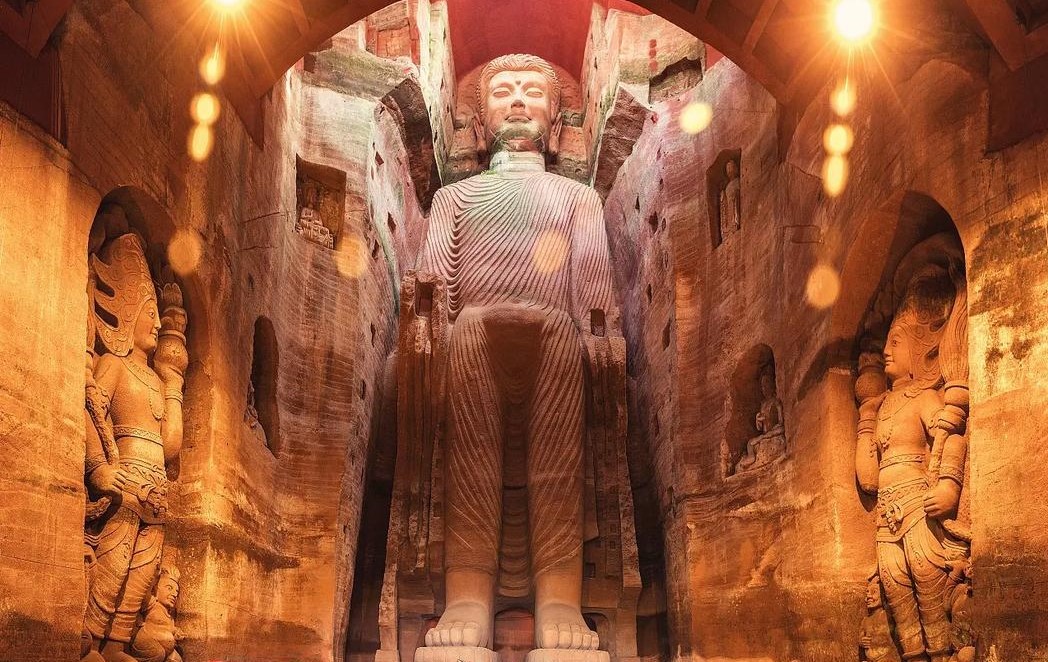
The Oriental Buddha Capital is adjacent to the Leshan Giant Buddha Scenic Area, located at the western foot of Lingyun Mountain. It is a large-scale Buddhist cultural theme scenic area opened in 1994, and together with the Leshan Giant Buddha, it forms the overall landscape of "Buddhist Paradise". The scenic area focuses on "displaying Buddhist cultural art", gathers the essence of Buddhist statue art at home and abroad, and combines modern sculpture technology with traditional cliff carving techniques to create a Buddhist cultural paradise integrating appreciation, culture and art.
The core highlight of the Eastern Buddha Capital is the world's largest reclining Buddha - "Eastern Reclining Buddha". Carved on the mountain, the reclining Buddha is 170 meters long and 24 meters high. It adopts cliff carving technology and echoes the Leshan Giant Buddha from a distance. The reclining Buddha has a serene expression, slightly closed eyes, right hand supporting the head, and left hand naturally placed on the side. The clothing lines are smooth and the details are exquisitely carved, showing the tranquility and detachment of the Buddha when he entered nirvana. There is also a "Five Hundred Arhats Corridor" in the scenic area, which is 500 meters long and houses 500 Arhat statues of different shapes. Each Arhat is 2-3 meters high, with different expressions and movements: some have kind eyebrows and kind eyes, some have angry eyes, some hold magic weapons, and some sit in meditation, vividly reproducing the various expressions of the Arhats. In addition, there are many scenic spots such as "Medicine Buddha Hall", "Guanyin Hall" and "Tathagata Golden Buddha" in the scenic area. Among them, the Tathagata Golden Buddha is 33 meters high, gilded all over, and magnificent, which is one of the landmark buildings of the scenic area. The Eastern Buddha Capital is shaded by green trees and gurgling water, and the Buddhist statues and natural landscapes complement each other, providing tourists with a good place to quietly feel the Buddhist culture.
6. Wuyou Temple
Wuyou Temple is located on the top of Wuyou Mountain, facing Lingyun Temple across the stream. Founded in the Tang Dynasty, it was originally named "Zhengjue Temple" and renamed "Wuyou Temple" in the Northern Song Dynasty. Because the mountain shape resembles a lying ox, it is also called "Woniu Temple." The temple is built along the mountain, with temples scattered in an orderly manner, perfectly integrating with the natural landscape of Wuyou Mountain, and is known as "the mountain is not high but beautiful, the water is not deep but clear."
The main buildings of Wuyou Temple include Tianwang Hall, Maitreya Hall, Mahavira Hall, Guanyin Hall, etc. Among them, the Mahavira Hall houses the "Three Saints of Huayan" statues of Sakyamuni Buddha, Manjusri Bodhisattva, and Samantabhadra Bodhisattva, which are solemn; the Thousand-Hand Guanyin statue in the Guanyin Hall is exquisitely crafted with a compassionate expression. The most famous scenic spot of the temple is the "Three Rivers Confluence Observation Deck" on the top of the mountain. Standing here, you can overlook the magnificent scene of the confluence of Minjiang River, Qingyi River, and Dadu River, and the whole view of Leshan Giant Buddha is all in sight, which is one of the best spots for taking photos of the Giant Buddha and the river scenery in the same frame. There is also the site of "Er Ya Tai" in the temple, which is said to be the place where Guo Sheren, a literary scholar of the Han Dynasty, annotated "Er Ya," with profound cultural heritage.


History and Significance
1. Origins of the Leshan Giant Buddha
The construction of the Leshan Giant Buddha began in 713 AD during the Tang Dynasty, under the initiative of the Buddhist monk Hai Tong. The purpose was to subdue the treacherous river currents near the confluence of three rivers. The monk believed that the Buddha's presence would calm the waters, allowing ships to pass safely. It took approximately 90 years to complete the sculpture, which was carved directly into the rock face of Lingyun Mountain.
The Buddha represents Maitreya, the future Buddha, sitting serenely with a gentle expression. The structure was not only a religious symbol but also a remarkable feat of engineering and artistry.
2. Cultural and Religious Importance
The Leshan Giant Buddha is a significant cultural and religious symbol for both Buddhism and the people of China. It stands as an enduring expression of Buddhist faith and is a popular pilgrimage site for Buddhists. Over the centuries, the Buddha has become a symbol of peace and serenity, embodying the wisdom of Buddhism.
In addition to its religious significance, the sculpture reflects the craftsmanship of Tang Dynasty artists and the technical mastery involved in carving such an enormous figure from solid rock.
Classic Tour Routes
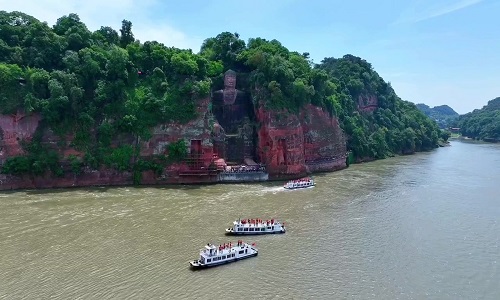
There are two primary ways to visit the Leshan Giant Buddha: hiking up the mountain and taking a cruise ship. Since hiking requires purchasing a scenic area ticket while the cruise does not, you can choose one option based on your itinerary, or opt to hike first and then take the cruise. If you are visiting for the first time and your physical condition permits, hiking up the mountain is highly recommended. Although taking a cruise is more relaxed and allows you to stop in front of the Buddha to take panoramic photos, the deck becomes very crowded when the ship reaches the viewing spot, resulting in limited viewing quality. If hiking is not feasible, taking a cruise is still the best choice to enjoy the full view of the Giant Buddha.
1. Hiking Guide
· Classic Hiking Route (approx. 2 hours)
North Gate — Xisheng Maitreya Cave — Su Shi's Inscribed "Fo" (Buddha) Character — Guanyin Cave — "Repent and Be Saved" Cliff Inscription — Three Rivers Confluence Viewing Platform — Longqiu Waterfall — Huxue Cave — Zaijiu Pavilion — Lingyun Temple — Leshan Giant Buddha — Haishi Cave — Buddha's Feet — Yuexie Pavilion — Su Garden — Exit via East Gate
· If you plan to take a cruise after hiking, you can take a sightseeing bus from the East Gate to Wuyou Wharf.
2. Cruise Guide
To take a cruise, navigate to the South Tourist Center; the departure dock is Wuyou Wharf. If starting from other tourist centers, it is recommended to take a sightseeing bus as the distance is relatively far.
* Cruise Details
· There are two main photo spots along the way: the "Pillar in the Midstream" cliff inscription and the Leshan Giant Buddha.
· The ship will stop for 5 minutes at the spot below the Buddha’s feet. Professional photographers on board offer free 5-inch group photos, and 8-inch high-resolution photos are available for purchase at 30 RMB per piece.
 One Day Chengdu Leshan Giant Buddha Tour with Authentic Tea Culture Leaning
 Full Day Chengdu Tour with Leshan Giant Buddha, Hot Pot & Sichuan Opera
Basic Information
1. Address
2435 Lingyun Road, Shizhong District, Leshan City, Sichuan, China
2. Ticket Types and Prices
· Regular Tickets: Adult ticket 80 RMB/person; student ticket 40 RMB/person with valid student ID (full-time undergraduate and below); elderly people aged 65 and above are free with ID card, elderly people aged 60-65 are 40 RMB/person with ID card; children with height 1.2 meters and below are free, children 1.2-1.4 meters are 40 RMB/person; disabled people are free with disability certificate, military personnel are free with officer certificate.
· Special Tickets: Cruise tickets are divided into regular cruise ships and luxury cruise ships. Regular cruise ships are 70 RMB/person, luxury cruise ships are 150 RMB/person (including guide service and tea); the scenic spot guide service has various packages, manual guide (within 5 people) 100 RMB/time, electronic guide device rental 30 RMB/unit (including earphones, reusable).
2. Opening Hours
· Apr 1–Oct 7 every year: 7:30 AM–6:30 PM;7:30 PM–10:30 PM (Admission ends at:9:30 PM)
· Every year from Oct 8 to Mar 31 of the following year: 8:00 AM–5:30 PM;7:00 PM–10:00 PM (Admission ends at:9:00 PM)
3. Reservation Channels
Tourists can make reservations and buy tickets through the official WeChat public account of "Leshan Giant Buddha Scenic Area," or buy tickets on third-party platforms such as Ctrip and Meituan. Personal identity information needs to be filled in when making reservations. There are also ticket windows on-site in the scenic spot, but it is recommended to make online reservations in advance during peak season to avoid queuing. International tourists need to make reservations and buy tickets with passports, and the scenic spot supports multiple foreign currency exchange services.
4. Ticket inquiry: +86-833-2355557
How to Get to Leshan Giant Buddha Scenic Area
1. Plane — High-speed Train/Coach
(1) After arriving at Chengdu Shuangliu International Airport by plane, visitors can take a high-speed train directly from Terminal T2 to Leshan Station (schedules may be adjusted during holidays or special circumstances).
· Fare reference: Business Class 137 RMB, First Class 73 RMB, Second Class 46 RMB, Standing-only Ticket 46 RMB.
(2) Upon arriving at Chengdu Shuangliu International Airport by plane, take Metro Line 10 from Terminal T2 and transfer to Line 3 to reach Chengdu Xinnanmen Tourism Bus Station. Then take a coach from here to Leshan Xiaoba Tourism Bus Station, which generally operates with rolling departures.
· Fare: 46 RMB.
2. Coach
· Chengdu Xinnanmen Tourism Bus Station — Leshan Xiaoba Tourism Bus Station: 46 RMB
· Chengdu Xinnanmen Tourism Bus Station — Leshan Giant Buddha Scenic Area: 53 RMB
· Chengdu East Railway Station Bus Terminal — Leshan Xiaoba Tourism Bus Station: 45 RMB
· Chengdu Shiyangchang Bus Station — Leshan Bus Terminal: 55 RMB
· Chengdu Chadianzi Bus Station — Leshan Bus Terminal: 48 RMB
3. High-speed Train
Visitors can take a high-speed train to Leshan High-speed Railway Station, then transfer to passenger coaches to reach Leshan Bus Terminal, Leshan Xiaoba Tourism Bus Station, or Leshan Intermodal Bus Station. All these stations are served by bus routes stopping at the Leshan Giant Buddha Scenic Area.
· High-speed trains to Leshan are available from both Chengdu East Railway Station and Chengdu South Railway Station.
· Fare reference from Chengdu East Railway Station: First Class CNY 86, Second Class CNY 54, Standing-only Ticket 54 RMB
· Fare reference from Chengdu South Railway Station: First Class CNY 81, Second Class CNY 51, Standing-only Ticket 51 RMB
4. Bus
Bus routes stopping at the Leshan Giant Buddha Scenic Area: K1 Bus, 601 Tourist Bus, Route 3, Route 13
Practical Travel Tips
1. Tour Preparation Tips
· Item carrying: Comfortable sports shoes (steep steps of Jiuqu Plank Road), sun protection products (many open-air areas in the scenic spot), rain gear (changeable mountain weather), portable water cup (few drinking points in the scenic spot).
· Document preparation: ID card (domestic tourists), passport (international tourists), student ID/senior citizen card and other discount certificates, check the validity period in advance.
2. Safety and Order Tips
· Safety precautions: The Jiuqu Plank Road is narrow, so you need to abide by the "one-way traffic" rule to avoid crowding; pay attention to anti-slip in riverside areas, and children need to be supervised by special personnel; avoid staying on open-air observation decks in thunderstorm weather.
· Civilized tour: Do not touch the Buddha statue and stone carving cultural relics, do not litter at will, abide by religious etiquette in temples, and do not make noise or frolic.
3. Season and Time Tips
· Best tour season: Spring and autumn (March-April, September-October, suitable temperature and lush vegetation); you can watch the river high tide landscape in summer, but you need to prevent heatstroke; there are few people and quiet in winter, and you can experience the culture in depth.
· Best tour time: It is recommended to enter the park before 8:00 AM in peak season (to avoid the peak of people flow); you can enjoy the wonder of "Golden Buddha reflecting the river" by boat at sunset, and you need to check the sunset time in advance.
The Leshan Giant Buddha is one of China’s most magnificent and awe-inspiring landmarks. Whether you’re a history enthusiast, a religious pilgrim, or simply someone looking to witness an extraordinary work of art, the Buddha offers something for everyone. With its peaceful presence overlooking the confluence of three rivers, the Leshan Giant Buddha is a must-see destination in Sichuan. Make sure to plan your visit to this ancient marvel and immerse yourself in its beauty, history, and spiritual significance.
Your Way Holiday’s Expert Guide to the Leshan Giant Buddha: A Journey to China’s Most Majestic Sculpture
We design private and tailor-made Chengdu tours customized to your travel style at affordable local prices. You’ll enjoy the comfort of a private, spacious car and the company of a professional local guide with over 5 years of experience, dedicated exclusively to you or your group. From transportation and tickets to authentic dining experiences (we always recommend the dishes most loved by locals), everything will be arranged according to your preferences. Please take a look at some of our most popular Chengdu tours below:
 Private Chengdu Leshan Tour: All Inclusive Leshan Giant Buddha Tour by High-speed Train/Car
 2-Day Chengdu Tour: City Tour with Panda Base and Leshan Giant Buddha
Not exactly what you’re looking for? Don’t worry — all of our Chengdu tours can be fully customized based on your interests, schedule, and budget. We specialize in creating unique Chengdu experiences that go beyond the guidebook, giving you the chance to truly connect with the local culture and people. Our enthusiastic tour experts are always ready to provide detailed suggestions and will respond to your inquiry within 24 hours. Ready to explore Chengdu your way? Contact us today and let us design a Chengdu shopping experience that fits your style. Your Way Holiday looks forward to your message! We're ready to design an unforgettable Chengdu trip for you anytime.